A harness evaluation published by Y Combinator CEO Garry Tan found that swapping the harness around the same model left 20-task pass rates indistinguishable, while cost per solved task differed by more than twofold.
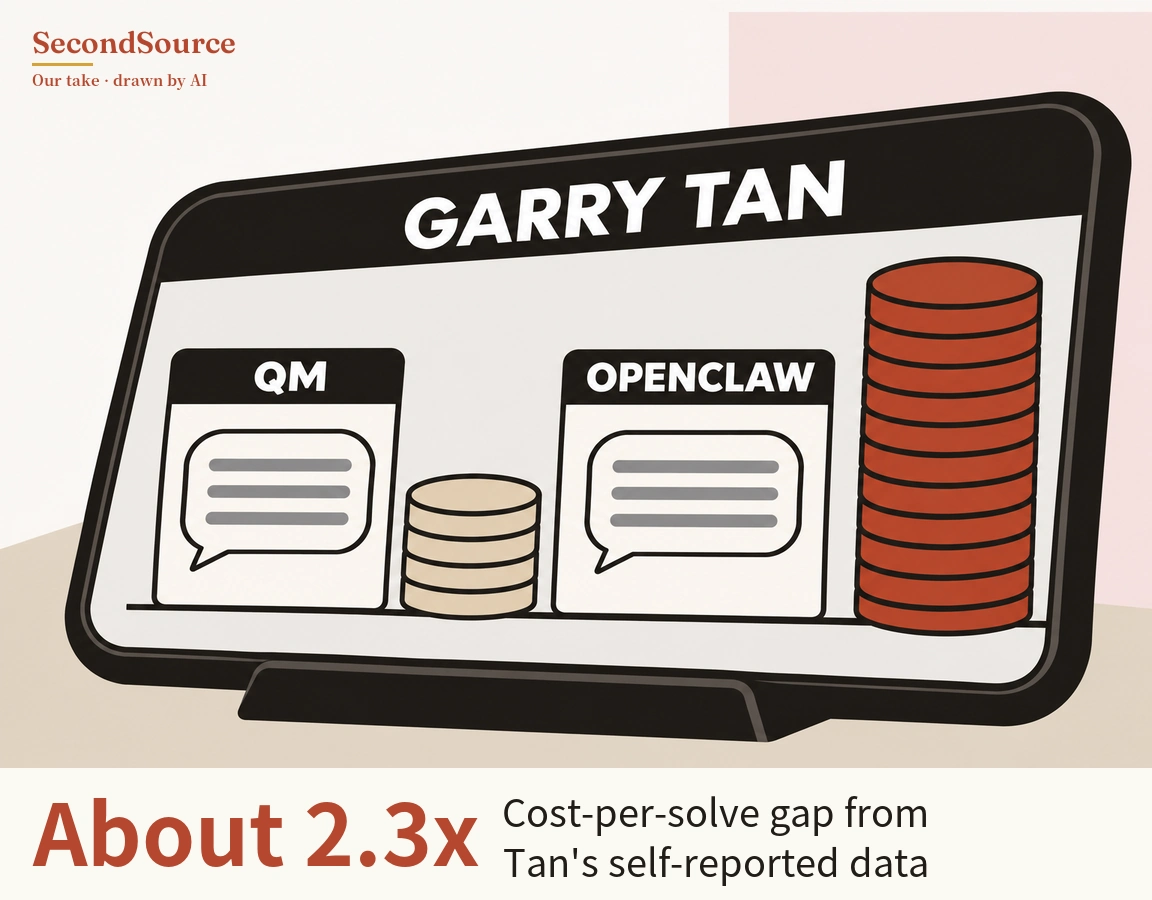
On this public task set the differences worth comparing are cost and time, according to Garry Tan's self-reported development results, and Tan and YC both have stakes in some of the harnesses. On Opus 5.5, YC's harness QM passed 72.5% at US$0.19 per solve, Claude Code 76.3% at US$0.22, Hermes Agent 78.8% at US$0.24 and OpenClaw 76.3% at US$0.44. The most expensive costs about 2.3 times the cheapest (our calculation). Time per run was 40.1 seconds for both QM and Claude Code, against 99.4 seconds for OpenClaw. The README states that pass rates across the pairings can't be told apart, and that these are development results on public tasks, not a held-out confirmation test. The README also discloses YC's investment in Hermes (g-harness-evals). How we checked →
Source and checks
This item ran in the brief of Nov 9, 2026, alongside 14 other items. How we checked it, the quote checks and what was still missing that day are on that issue's How we checked page.
Cite this item
SecondSource (2026). "A harness evaluation published by Y Combinator CEO Garry Tan found that swapping the harness around the same model left 20-task pass rates indistinguishable, while cost per solved task differed by more than twofold.." https://secondsource.io/en/research/2026-11-09-1/. Accessed access date.