SecondSourceJudgment rebuilt from primary sources

NVIDIA board probes spy report on Huang, silent on exports
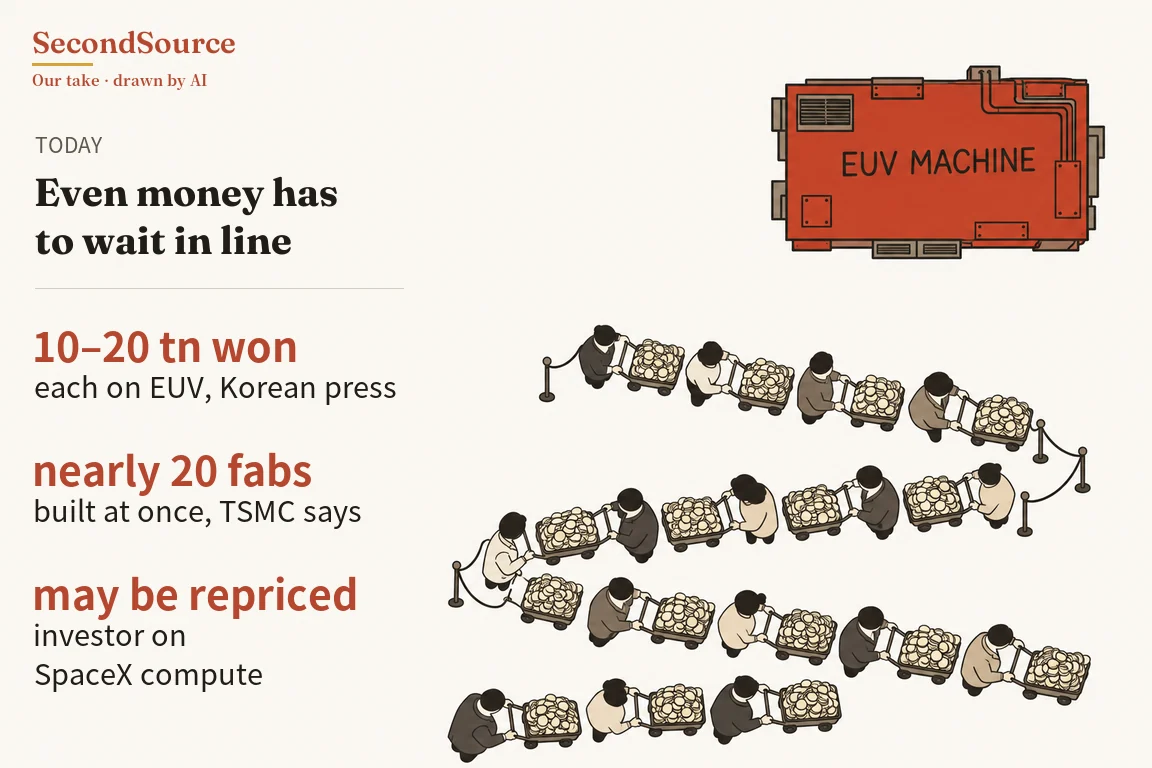
Today's front-page cover: Even money has to wait in line; 10–20 tn won each on EUV, Korean press; nearly 20 fabs built at once, TSMC says; may be repriced investor on SpaceX compute

At a glance

1. NVIDIA's board said on November 8 that independent directors will oversee an inquiry into reports that foreign intelligence targeted CEO Jensen Huang. Three House committee chairs separately want Huang at a closed-door briefing on November 18, the day after earnings. Neither document mentions where H200 chips went.

2. Samsung and SK hynix are competing for ASML's EUV tools, and lead times may stretch to twice the longest on record, according to Taiwan chip commentator Dan Nystedt's relay of South Korea's Chosun Ilbo. Nystedt gives no length for that record.

Today's main line

1. NVIDIA's board inquiry, overseen by independent directors, sets no finish date, and the board's statement never mentions the H200

NVIDIA's board announced on November 8 an independent investigation into reports that CEO Jensen Huang has been the target of a foreign intelligence effort (CNBC, full text of the statement). Our inference: for NVIDIA investors and export-compliance teams, a clean result from the board's inquiry into the spy reports won't answer whether NVIDIA chips reached restricted Chinese buyers unless the board publicly says the inquiry checked chip flows.

NVIDIA's board statement names neither Megaspeed, a cloud customer of NVIDIA in Singapore, nor export controls.

The November 4 letter from three House committee chairs asks about NVIDIA's counterintelligence measures and Huang's dealings with a Megaspeed executive (the letter).

Approved H200 sales are a separate thread, and the board statement doesn't mention them.

2. Samsung and SK hynix are competing for ASML's EUV tools, each committing 10 trillion to 20 trillion won, according to Dan Nystedt's relay of Chosun Ilbo
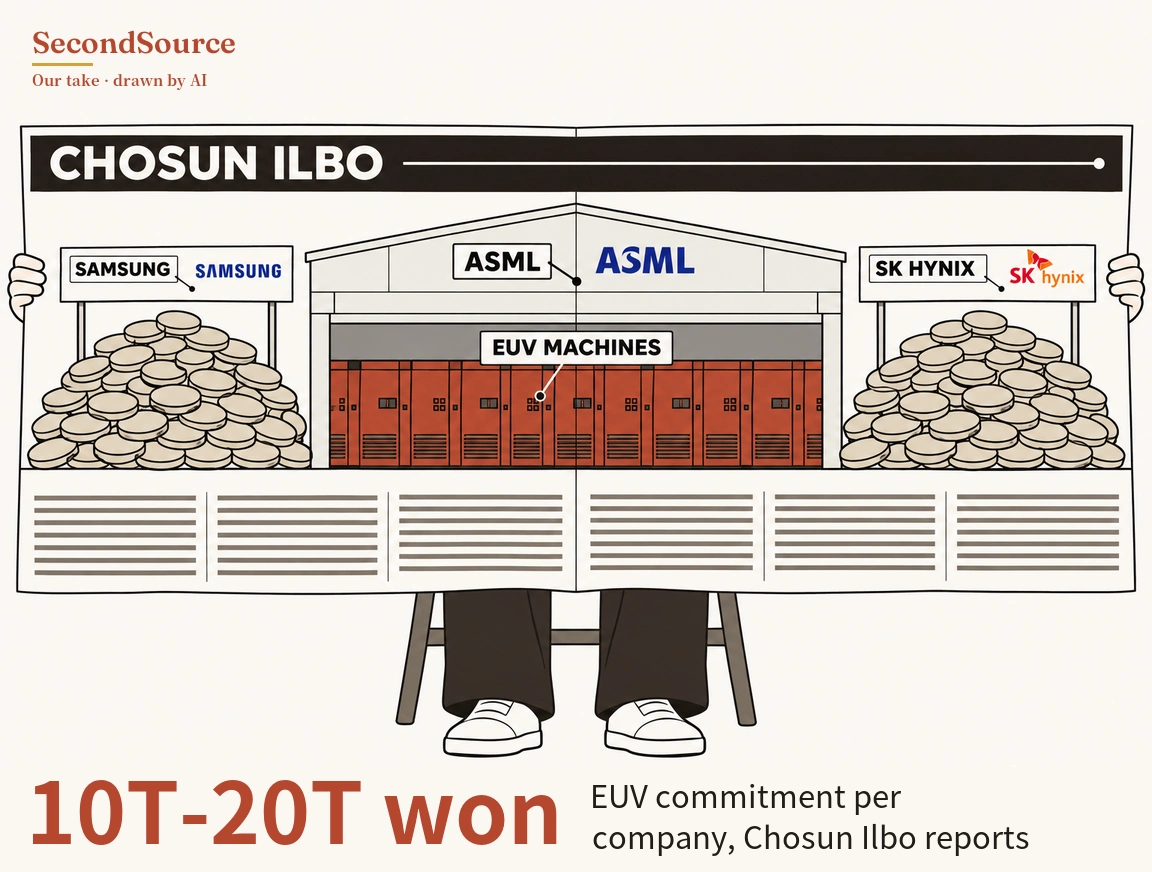
Concept illustration: two hands at the left and right edges hold up a large open newspaper with a black masthead lettered CHOSUN ILBO, and below it appear legs in dark trousers, white shoes and the wooden legs of a chair. At the centre of the page a pitched-roof hall lettered ASML holds a row of red cabinet-like machines, joined by a thin line to a tag lettered EUV MACHINES; to its left a signboard lettered SAMSUNG and to its right a signboard lettered SK HYNIX each stand above a large heap of coins, and six columns of grey lines fill the lower part of the page. Printed on the image: 10T-20T won EUV commitment per company, Chosun Ilbo reports.
Samsung and SK hynix are competing to buy ASML's EUV tools for delivery in 2027 and 2028, and lead times may lengthen, according to Taiwan chip commentator Dan Nystedt's relay of South Korea's Chosun Ilbo. Chosun Ilbo says lead times may stretch to twice the longest on record, and Nystedt gives no year for that record and no tool counts for either company. The investment sums and the lead-time multiple are unverified figures from Chosun Ilbo alone, unconfirmed by ASML or customers.

Our inference: for memory investors and supply-chain teams planning for 2027 and 2028, how fast DRAM capacity grows may depend on who gets ASML tools first, if lead times really do lengthen.

Chips & semiconductors
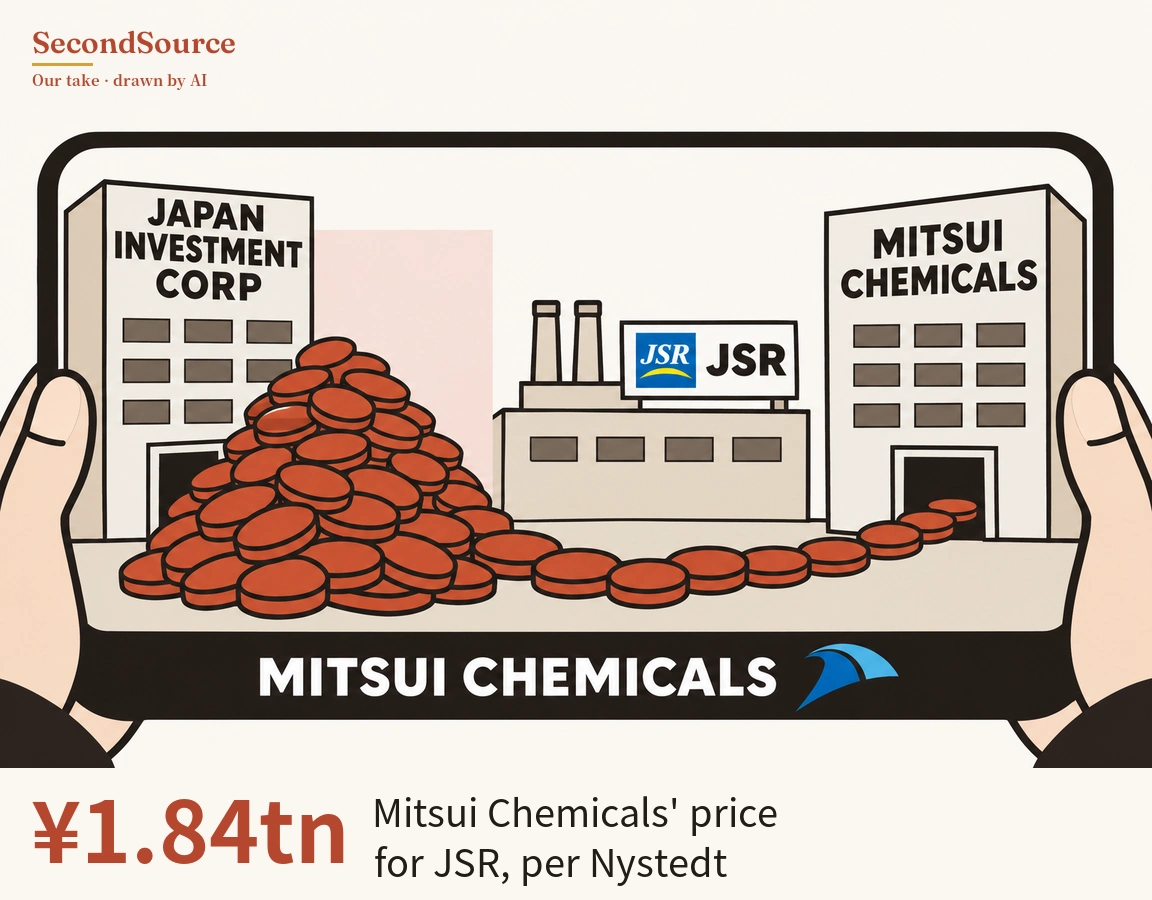
1. Mitsui Chemicals is buying photoresist maker JSR from state-backed Japan Investment Corp. for ¥1.84 trillion, according to Dan Nystedt's relay of Singapore's CNA.

Concept illustration: two hands hold a black-framed, round-cornered screen from the left and right; on it a building lettered JAPAN INVESTMENT CORP stands at left, a building lettered MITSUI CHEMICALS at right, and between them a low factory with two chimneys and a rooftop sign lettered JSR, while the black lower frame reads MITSUI CHEMICALS in white beside a blue curved mark. A large heap of red-orange coin-like discs sits in front of the left building, and a single-file line of discs runs from the dark doorway of the right building along the ground in front of the factory, leftward to the heap. Printed on the image: ¥1.84tn Mitsui Chemicals' price for JSR, per Nystedt.
According to Dan Nystedt's relay of Singapore's CNA, Mitsui Chemicals is buying photoresist maker JSR from Japan Investment Corp., a state-backed fund, and Mitsui Chemicals' investor-relations page lists the notice of the share purchase agreement. This paper's calculation from the two prices Nystedt relayed puts Mitsui Chemicals' price at about 2.04 times the ¥904 billion Japan Investment Corp. paid in 2023, and the relay doesn't say whether both prices cover equity only and exclude debt.

2. According to Taiwan's Economic Daily News, TSMC co-COO Cliff Hou said nearly 20 fabs are under construction at once worldwide, and customers have asked whether that can reach 30.

Concept illustration: a hand at the right grips a black rounded frame held sideways, its top bar showing a white tag lettered "tsmc" beside large white letters "TSMC". Inside the frame, a person in a long dark coat stands at the left with hands in pockets, looking up at a wide thought cloud, linked to it by two small bubbles, that holds a dashed outline of a long building with three raised sections; below the cloud a red building with two raised sections is surrounded by scaffolding, with a tower crane standing at its center and a small block hanging from the crane's hook. Printed on the image: Nearly 20 TSMC fabs being built, per Economic Daily News.
According to Taiwan's Economic Daily News, TSMC co-COO Cliff Hou said customers have asked whether the number of fabs under construction at once worldwide can reach 30. Dan Nystedt's English relay says the answer was no because the industry can't handle that scale yet given labor shortages and other problems at construction sites, an account TSMC hasn't confirmed.

Named commentary

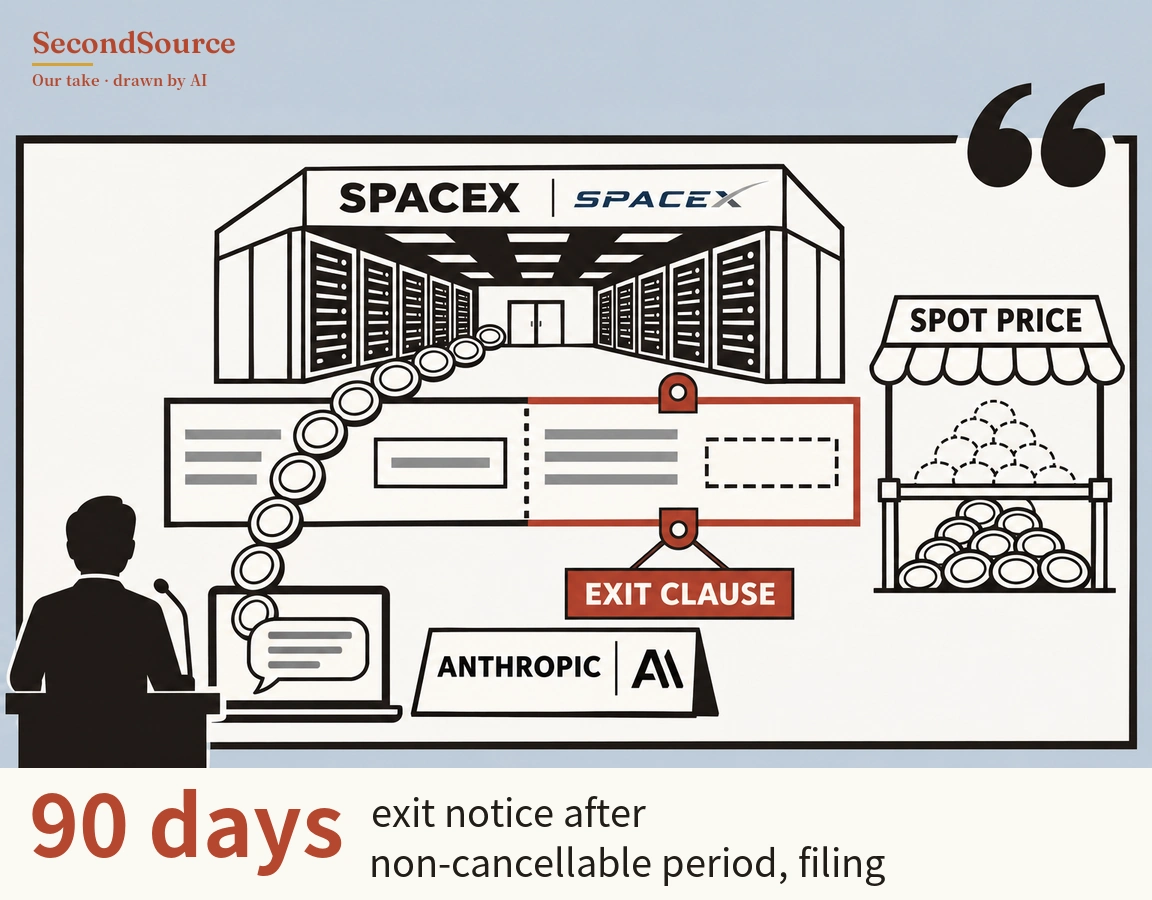
1. Investor Chamath Palihapitiya said on the All-In podcast that SpaceX and Anthropic can each exit their compute contract on 90 days' notice, and that the price could be reset if spot rates climb past a threshold, but SpaceX's IPO filing allows that exit only after a non-cancellable period.

Concept illustration in a black-framed white panel with large black quotation marks at its top right corner: at top centre a hall of server racks recedes to double doors under a header lettered SPACEX in bold capitals and again in stylised blue letters, and at right a market stall with an awning lettered SPOT PRICE holds a pile of solid coins below a rail and dashed-outline coins above it. Across the middle runs a long document strip split by a dashed line, its left half outlined in black with grey lines and a box holding a grey bar, its right half outlined in red with grey lines and an empty dashed box, with a red tab at its top and bottom edges and a red sign lettered EXIT CLAUSE hanging from the lower tab; at lower left a black silhouette of a person stands behind a lectern with a microphone beside a laptop overlapped by a speech bubble, a curving chain of coins, smaller toward the hall, passes over the strip's left half and joins the laptop to the hall floor, and at bottom centre stands a nameplate lettered ANTHROPIC beside a black symbol. Printed on the image: 90 days exit notice after non-cancellable period, filing.
Investor Chamath Palihapitiya said on the All-In podcast that the price of the SpaceX-Anthropic compute contract could be reset if the spot price for renting compute short term climbs past a threshold, which is Palihapitiya's personal judgment. Palihapitiya estimates the spot price could be two or even three times the price SpaceX currently charges Anthropic, and the current contract's unit price isn't public.

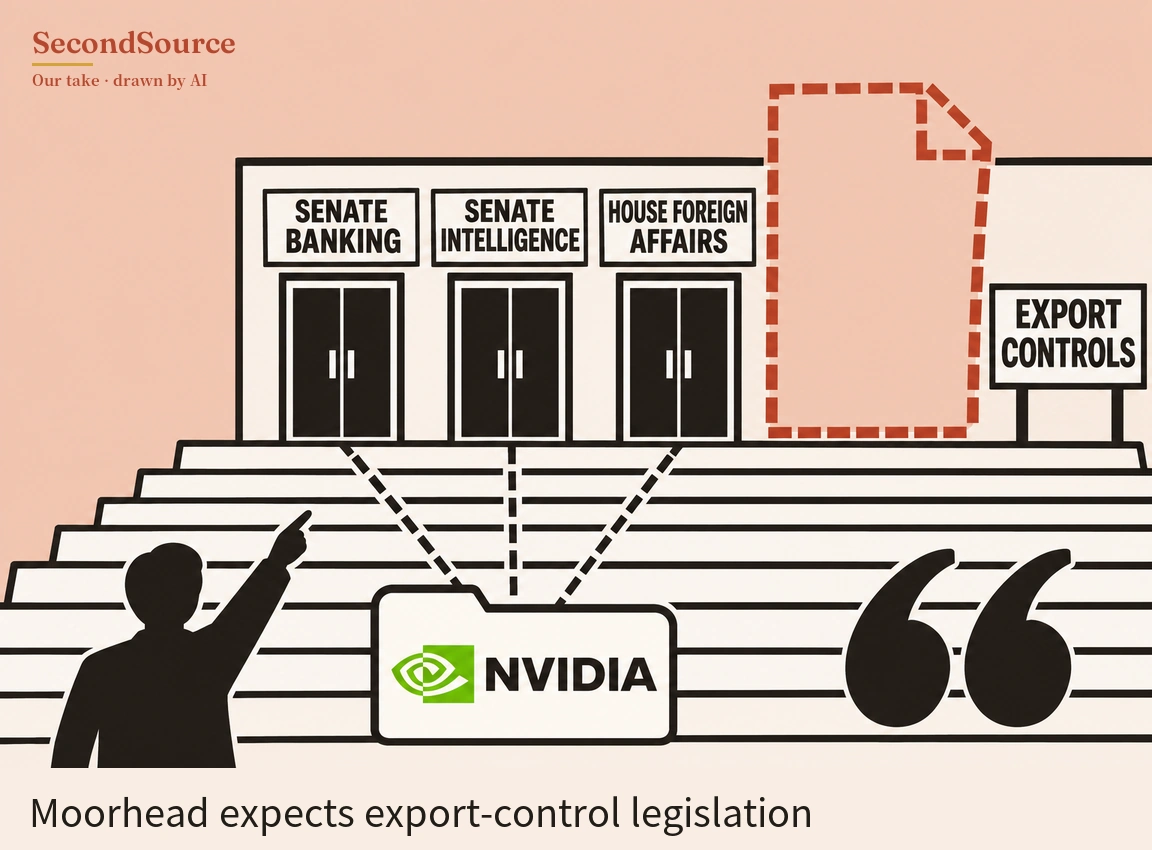
2. Industry analyst Patrick Moorhead expects the Senate Banking and Intelligence committees and the House Foreign Affairs Committee all to investigate the Huang matter, and says some form of export-control legislation may pass this year or next.

Concept illustration: a wide flight of steps leads up to a building with three black double doors side by side, under signs lettered SENATE BANKING, SENATE INTELLIGENCE and HOUSE FOREIGN AFFAIRS, and a dashed line runs down from each door to a single folder on the steps bearing a green emblem and the lettering NVIDIA. To the right of the doors are a red dashed outline of a page with a folded corner and a sign on two posts lettered EXPORT CONTROLS; at lower left a black silhouette of a person raises an arm and points up and to the right toward the building, and at lower right is a large pair of black quotation marks. Printed on the image: Moorhead expects export-control legislation.
Industry analyst Patrick Moorhead expects the Senate Banking and Intelligence committees and the House Foreign Affairs Committee all to investigate the Huang matter, and says many of these investigations will be public. Some form of legislation affecting NVIDIA may pass in this year's National Defense Authorization Act or next year, a forecast from Moorhead citing unnamed Washington sources, and no bill text or official motion has appeared so far.

Research & models

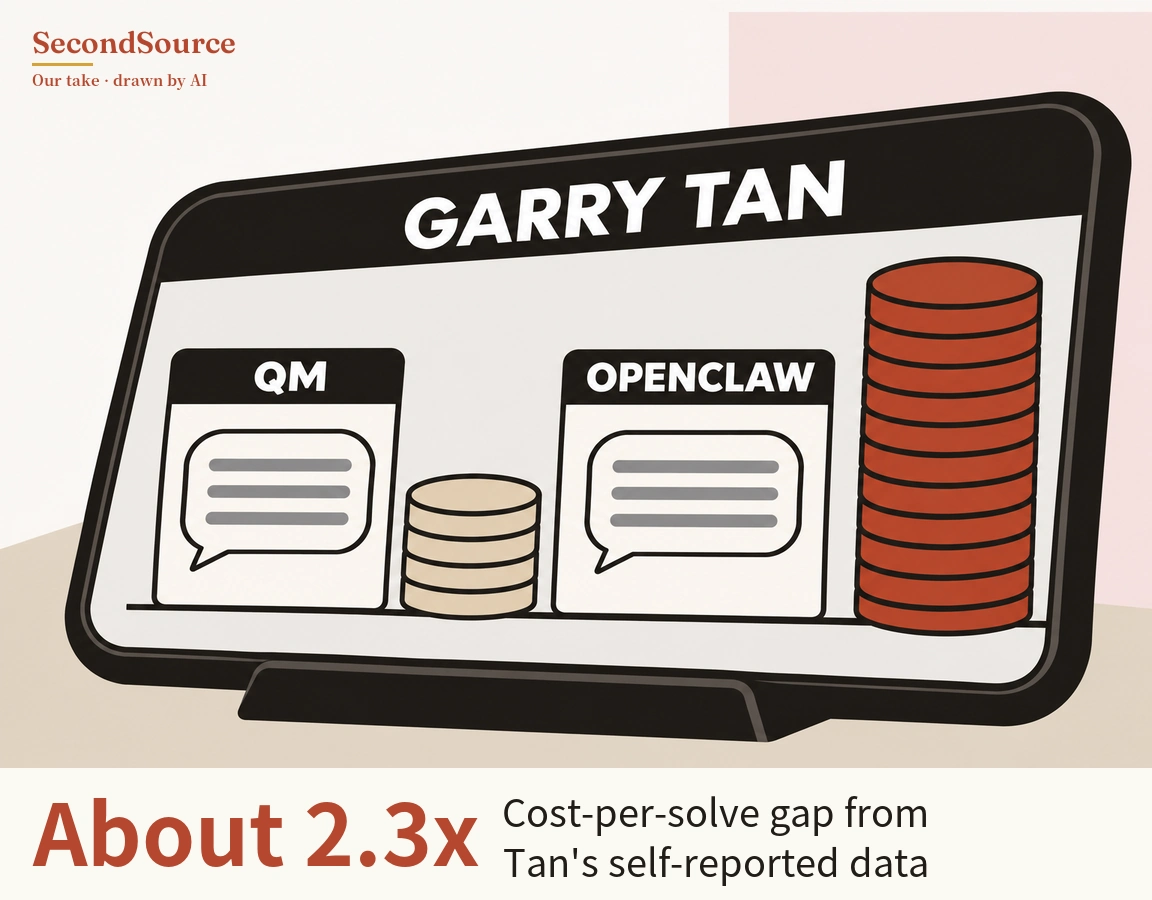
1. A harness evaluation published by Y Combinator CEO Garry Tan found that swapping the harness around the same model left 20-task pass rates indistinguishable, while cost per solved task differed by more than twofold.

Concept illustration: a black-framed display on a stand, tilted with its right side higher, has a black band with white capital lettering across the top of its screen. Below the band a thin black line runs across the screen and holds, from left to right, a card lettered QM containing a speech bubble with three grey bars, a short stack of beige discs, a card lettered OPENCLAW containing the same kind of bubble, and a much taller stack of red discs that rises to near the black band. Printed on the image: About 2.3x Cost-per-solve gap from Tan's self-reported data.
A harness evaluation published by Y Combinator CEO Garry Tan found that swapping the harness around the same model left 20-task pass rates indistinguishable. On Opus 5.5, OpenClaw cost the most per solved task and YC's harness QM the least; the pass rates and costs are Garry Tan's self-reported development results on public tasks, not a held-out confirmation test, and Tan and YC both have stakes in some of the harnesses.

2. A preprint says that with a 27B model and a budget for 100 agents, squads of 10 agents working in parallel beat 100 independent agents on 10 of 12 long tasks.(paper dated November 6)
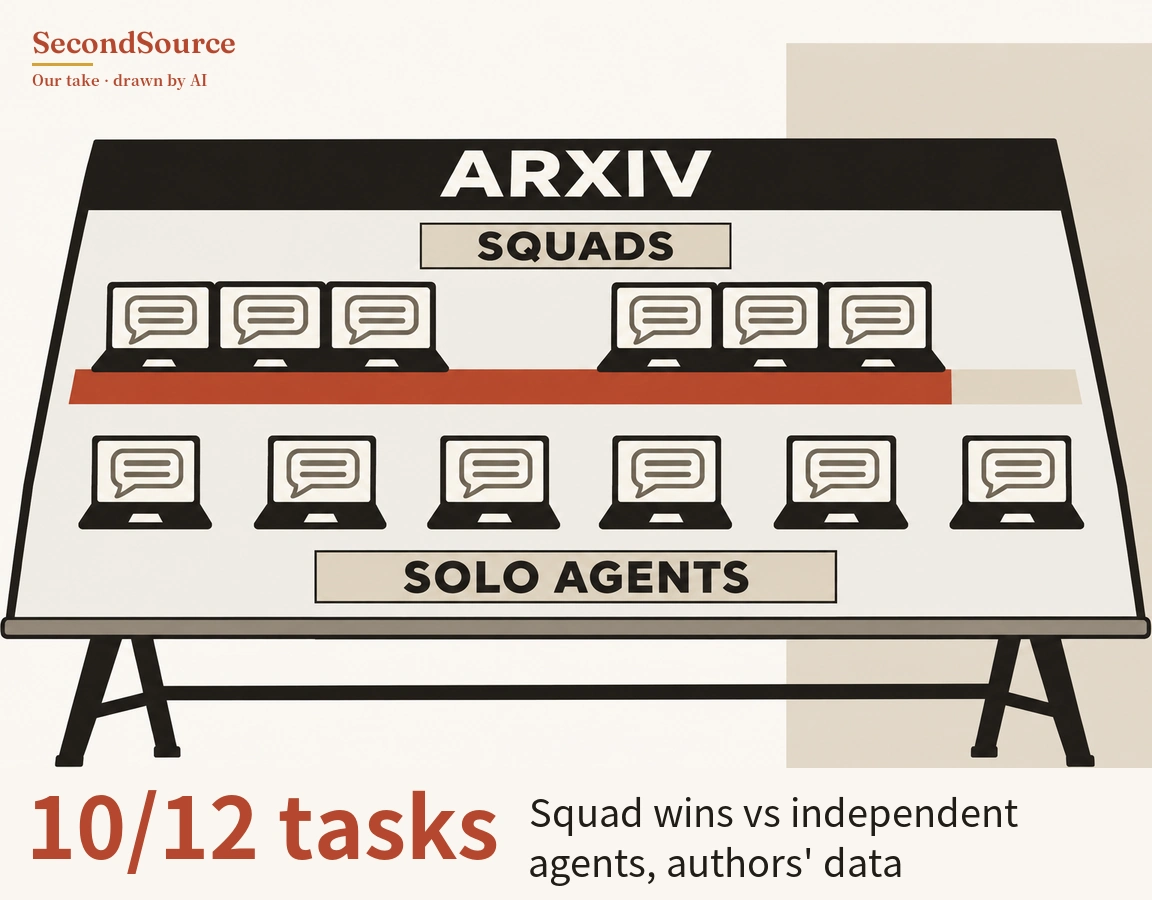
Concept illustration: a large board on black trestle legs has a black header lettered ARXIV, and under a label reading SQUADS two groups of three laptops placed side by side, each screen showing a speech bubble, sit on a long red bar that runs from the left along a pale strip and stops short of its right end. Below the bar, six separate, evenly spaced laptops with the same speech bubbles form a row above a label reading SOLO AGENTS. Printed on the image: 10/12 tasks Squad wins vs independent agents, authors' data.
A preprint compares parallel agent squads with independent agents on long tasks, giving a 27B model the same agent budget both ways, and all results are the authors' self-reported data that assume an automated grader can score each attempt. At equal spend, the squads beat a frontier model on half of the tasks, also according to the authors, and the abstract doesn't say which model.

3. Three identical syndicated copies of a news story lead some small models to accept false claims as true, according to a preprint.(paper dated November 6)
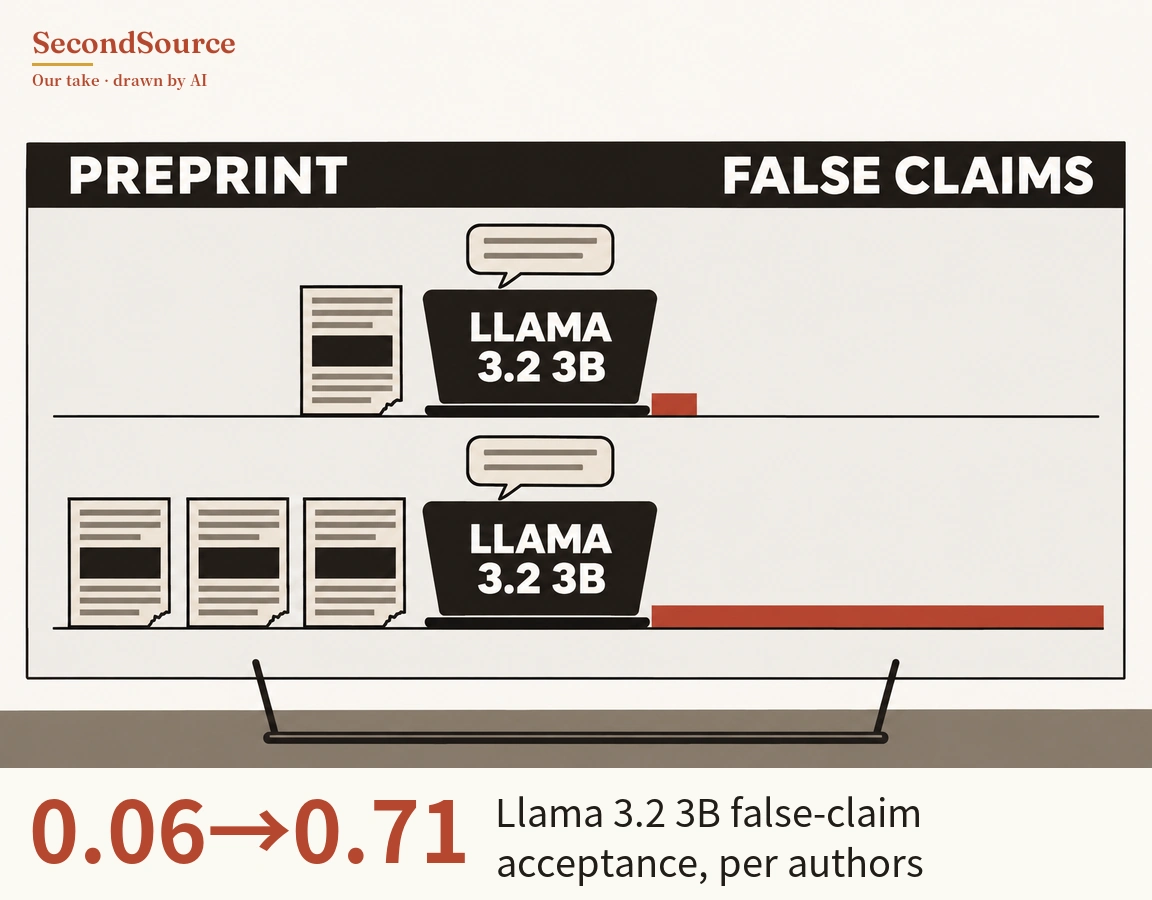
Concept illustration: a large white board on a two-legged stand has a black header lettered PREPRINT at left and FALSE CLAIMS at right, above two rows that each stand on a horizontal line. The top row has one sheet of paper with a torn corner to the left of a black trapezoid lettered LLAMA 3.2 3B, with a speech bubble above it and a short red bar to its right; the bottom row has three matching sheets side by side to the left of the same lettered trapezoid and speech bubble, with a long red bar stretching almost to the board's right edge. Printed on the image: 0.06→0.71 Llama 3.2 3B false-claim acceptance, per authors.
A preprint says three identical syndicated copies of a news story lead some small models to accept false claims about unfamiliar people as true more often than one report does, in the authors' self-reported results, which mostly cover small models. Llama 3.2 3B and phi4 14B believed the reports even when prompted that all of the reports came from one source, while Gemini 2.5 Pro followed that source hint.

Product moves

1. NVIDIA, Korean AI-chip company Rebellions and South Korean carrier SK Telecom announced that Rebellions' R200 will connect to the NVIDIA platform through NVLink Fusion, NVIDIA's interconnect opened to outside chips, with systems not expected to be deployable until 2028.(NVIDIA Newsroom, 2026-11-08)

From the archive

1. [Looking back] (SecondSource reading of July 14) SecondSource's bet is that, before mid-July 2027, no two named large enterprises will publicly replace code-completion copilots with coding agents that take on whole jobs and cancel the copilot subscriptions.

Enterprise AI coding budgets this year are more likely to stack the two products, and whether replacement has begun depends on the count of named companies publicly cancelling subscriptions.

Also happened

1. Not verified by us yet: (reported November 6) According to Michael Parekh's relay of The Information, TSMC is studying 3D DRAM production at NVIDIA's request, with no mass-production timetable (Michael Parekh, 2026-11-08).

2. Not verified by us yet: According to Paul Triolo's repost of Reuters citing the Financial Times, Anthropic has locked in about US$3.4 billion of data-center generator orders; the counterparty is unknown (Paul Triolo, 2026-11-08).

3. Not verified by us yet: According to Dan Nystedt's relay of Nikkei, a procurement team from TeraFab, Elon Musk's own chip-fab project, visited equipment makers in Japan, with mass production targeted for 2032 (Dan Nystedt, 2026-11-09).

4. Not verified by us yet: SemiAnalysis says AMD's MI355 running the inference software TileRT delivers 1.42 times the per-user speed of NVIDIA's GB300 NVL72 on long-context workloads; the GB300 configuration isn't public (SemiAnalysis, 2026-11-08).

SecondSource isn't a news digest: AI reads primary sources across fields, every judgment comes with its original source, and mistakes are corrected in public. The focus is what has changed and which claims still lack evidence, not what happened today.

Written from the same research and judgments as the Traditional Chinese edition. Sources are linked; we distinguish original documents from reporting and mark what we could not verify.