A preprint says that with a 27B model and a budget for 100 agents, squads of 10 agents working in parallel beat 100 independent agents on 10 of 12 long tasks.
(paper dated November 6)
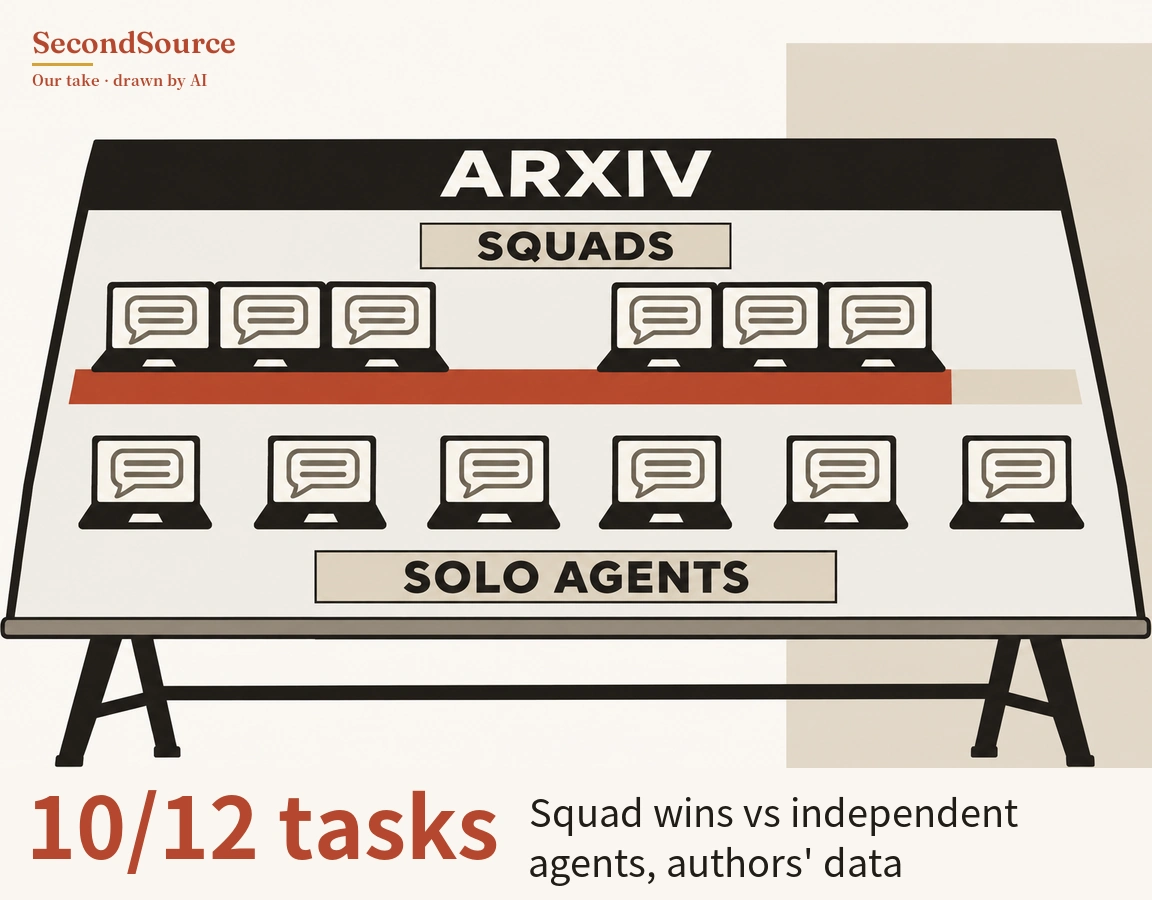
Engineering leads who can score each attempt with an automated grader may get better results by organizing an agent budget into small squads, according to the authors' self-reported data. On the 4 tasks where a single team of 100 agents was run, the 10-agent squads won all 4. At equal spend, the squads beat a frontier model on half of the tasks, and the abstract doesn't say which model (arXiv 2611.09798, 2026-11-06). Next to watch: whether an independent team repeats the experiment. How we checked →
Source and checks
This item ran in the brief of Nov 9, 2026, alongside 14 other items. How we checked it, the quote checks and what was still missing that day are on that issue's How we checked page.
Cite this item
SecondSource (2026). "A preprint says that with a 27B model and a budget for 100 agents, squads of 10 agents working in parallel beat 100 independent agents on 10 of 12 long tasks.." https://secondsource.io/en/research/2026-11-09-2/. Accessed access date.