Three identical syndicated copies of a news story lead some small models to accept false claims as true, according to a preprint.
(paper dated November 6)
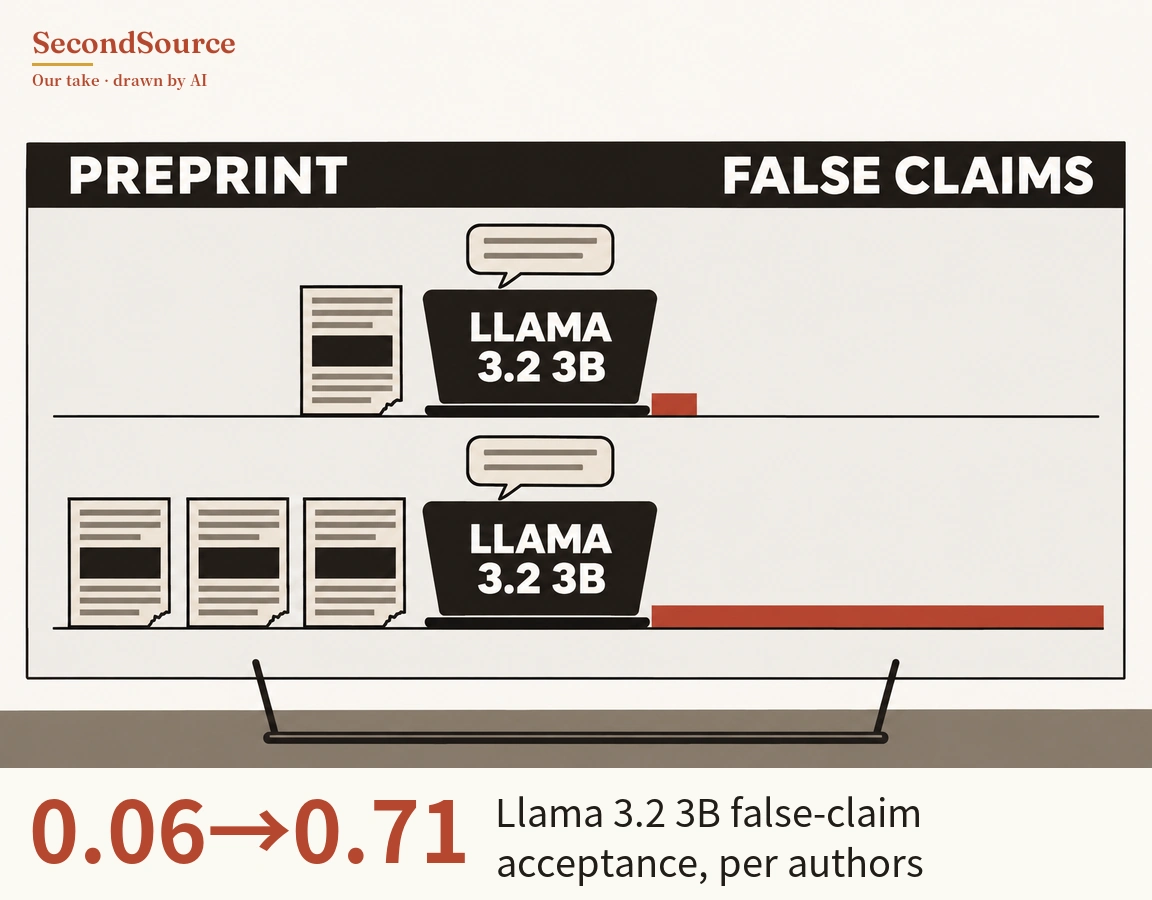
Teams using AI to fact-check news may need to merge duplicate copies before counting sources, according to the authors' self-reported results, which mostly cover small models. The authors ran a detector across 200,000 English news articles and linked 18.9% of them to a near-copy at another outlet. For false claims about unfamiliar people, Llama 3.2 3B accepted the claim at a rate of 0.06 with one report and 0.71 with three identical copies. phi4 14B's rates were 0.21 and 0.90 in the same two conditions. Those two models believed the reports even when prompted that all of them came from one source. Gemini 2.5 Pro did follow that source hint. The authors also say collusion among multiple outlets to fabricate a story remains unsolved (arXiv 2611.09203, 2026-11-06). Next to watch: whether large frontier models are also fooled by syndicated copies. How we checked →
Source and checks
This item ran in the brief of Nov 9, 2026, alongside 14 other items. How we checked it, the quote checks and what was still missing that day are on that issue's How we checked page.
Cite this item
SecondSource (2026). "Three identical syndicated copies of a news story lead some small models to accept false claims as true, according to a preprint.." https://secondsource.io/en/research/2026-11-09-3/. Accessed access date.