Deep Dive Oct 24, 2026
Horizontal AI spending mostly goes to assistants sold by office-suite makers and model companies

This report crosses: enterprise software strategy, corporate AI spending surveys, workplace-platform data-access policy, outcome-based pricing. Primary documents read: 2.
Key takeaways
An AI agent at work is an AI program that carries out several steps in a row for an employee, such as looking things up or answering a customer email. In 2024, start-ups building agents split into two camps. The horizontal camp wanted to give the whole company one general tool, so that employees who don't write code could build their own agents. The vertical camp sold ready-made agents for one job or one industry. Sierra, a start-up that builds customer-service agents, and Harvey, a start-up that builds agents for lawyers, are examples.
The opening conclusion is short. The horizontal approach was not wrong. But the money follows the place where employees already work, and the companies that own that place collect most of it, not the start-ups that bet on horizontal. Connecting agents to company data is no longer an advantage nobody can copy. The advantage now belongs to whoever holds the data and decides what an agent may read and write. Vertical companies have not been squeezed out. They survive by borrowing those entry points.
The entry point here means the office software and chat window employees open every day. Two kinds of company own it. Office-suite makers sell the whole bundle of work software: Microsoft and Google. Model companies sell business versions of their chat assistants directly: OpenAI and Anthropic. The 2024 debate was about which road a start-up should take. Two years later, the biggest earners on the horizontal road are these two kinds of company, which were not part of that debate. In this report, "horizontal" always means the approach of one general tool for the whole company, whoever sells it.
This report therefore measures 2026 by one yardstick: how close each player sits to the employee's entry point. That gives three positions. Owners of the entry point are the suite makers and model companies. Borrowers of the entry point are the vertical companies. Independent horizontal platforms are start-ups that only make horizontal tools and own no entry point.
Menlo Ventures is a venture firm that surveys US corporate AI spending every year. Menlo estimates horizontal AI spending in 2025 at US$8.4 billion. Of that, 86% went to AI assistants built into those entry points, such as Copilot inside Microsoft's office software. Sections two to four follow the money and the seats, section five the data, section six the vertical companies, and section seven returns to the 2024 question.
One: The two bets of 2024, let the whole company build or sell finished agents by job
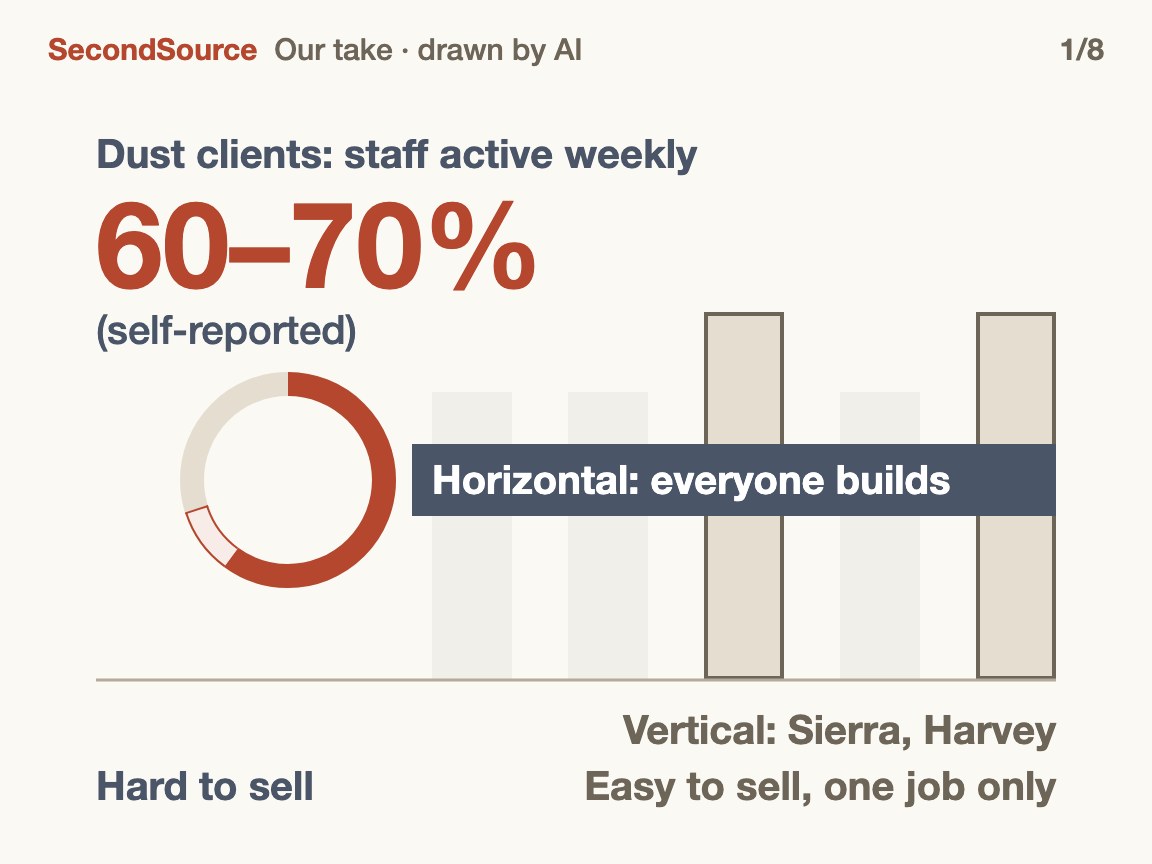
Dust is a French start-up that makes a platform for building agents inside companies. In November 2024, Dust co-founder Stanislas Polu told the tech podcast Latent Space that Dust is horizontal by nature. In his account, the uses come from the employees who can build agents, and those employees need not be engineers. Polu also conceded that a vertical product sells on one line about solving lawyers' problems, while a horizontal platform is much harder to sell.
The payoff Polu pointed to was penetration, meaning the share of a company's employees who actually use the tool. Dust reported that on average 60% to 70% of a customer's employees use it each week. That figure is Dust's own. Polu also said Dust's real constraint was the engineering needed to connect agents to a company's many data sources, not whether the model was smart enough.
Four days later, Flo Crivello, founder of the agent-tool maker Lindy, made a comparison with search on the same podcast. The general-purpose Google wins in almost every field. Crivello predicted many vertical agents, plus a small number of very large horizontal ones.
The other side was argued by Sierra CEO Bret Taylor. In a 2025 interview with Stratechery, the paid technology newsletter, Taylor argued that agents would split by job, with one company growing up for each department. In his view the packaged compliance and workflow are the value. He also said that once everyone can build agents, the pendulum would swing back toward platforms.
Both camps were arguing about how a start-up should sell agents. The next sections look at how much went to the side that stood outside the argument and owned the entry point.
Two: Where the money goes, most "horizontal" spending pays for assistants built into office software or chat windows
Menlo Ventures' December 2025 survey asked 495 AI decision-makers at US companies. From their answers it estimated that companies spent US$19 billion on generative AI at the application layer in 2025, meaning the software employees use rather than the models underneath. Menlo splits that layer three ways. Horizontal tools are used across every job, which matches this report's meaning. Departmental tools serve one job, such as writing code or customer service. Vertical-industry tools serve one industry, such as healthcare or law.
Those figures come from a single questionnaire, not from billing data. Menlo set the categories itself. Menlo is also an investor in Anthropic.
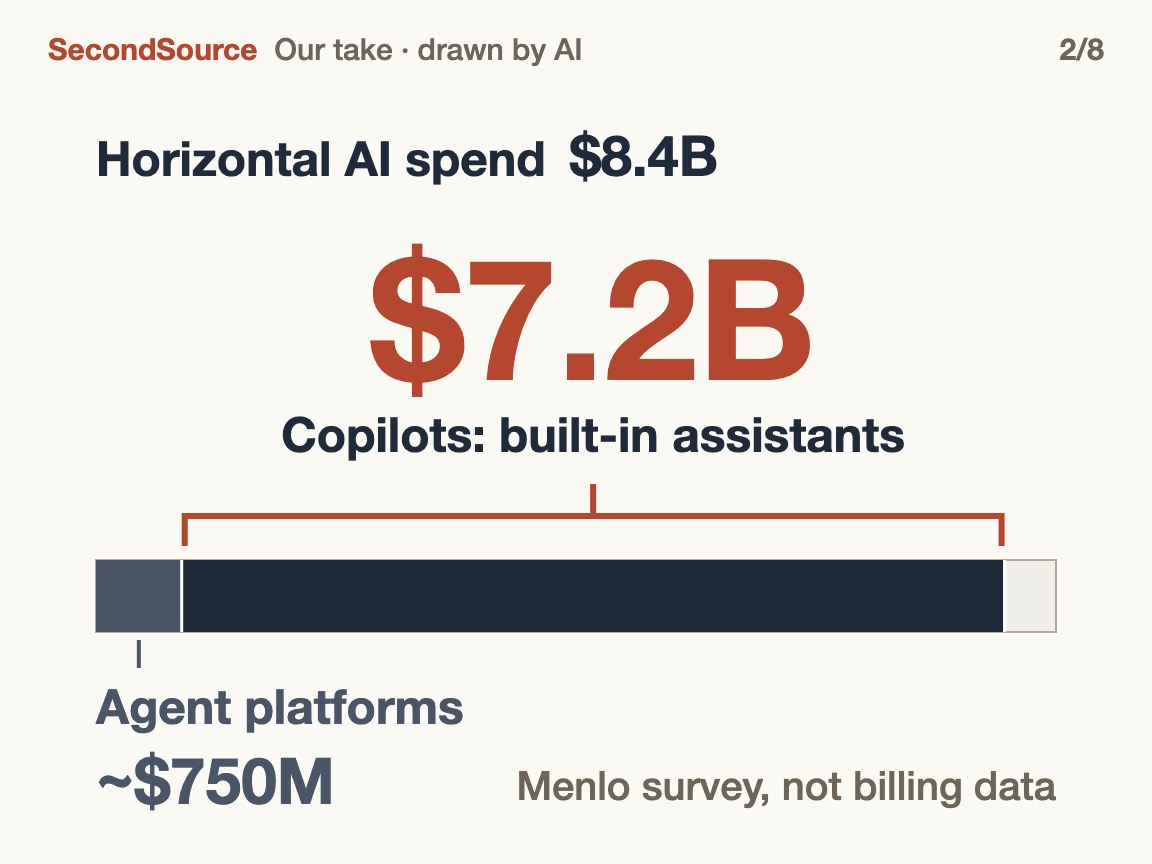
Horizontal is the largest single category, at US$8.4 billion. Of that, US$7.2 billion, or 86%, went to AI assistants built into office software or chat windows. The report names ChatGPT Enterprise, Claude for Work and Microsoft Copilot, all three sold by companies that own an entry point.
Products Menlo classes as agent platforms took about US$750 million, less than a tenth of horizontal spending. The report's examples of agent platforms include Agentforce, from the customer-management software giant Salesforce, and Glean. So even that US$750 million does not all belong to independent start-ups.
Three: The entry point sits with the suite makers, with large seat and registration counts and no daily-use figures
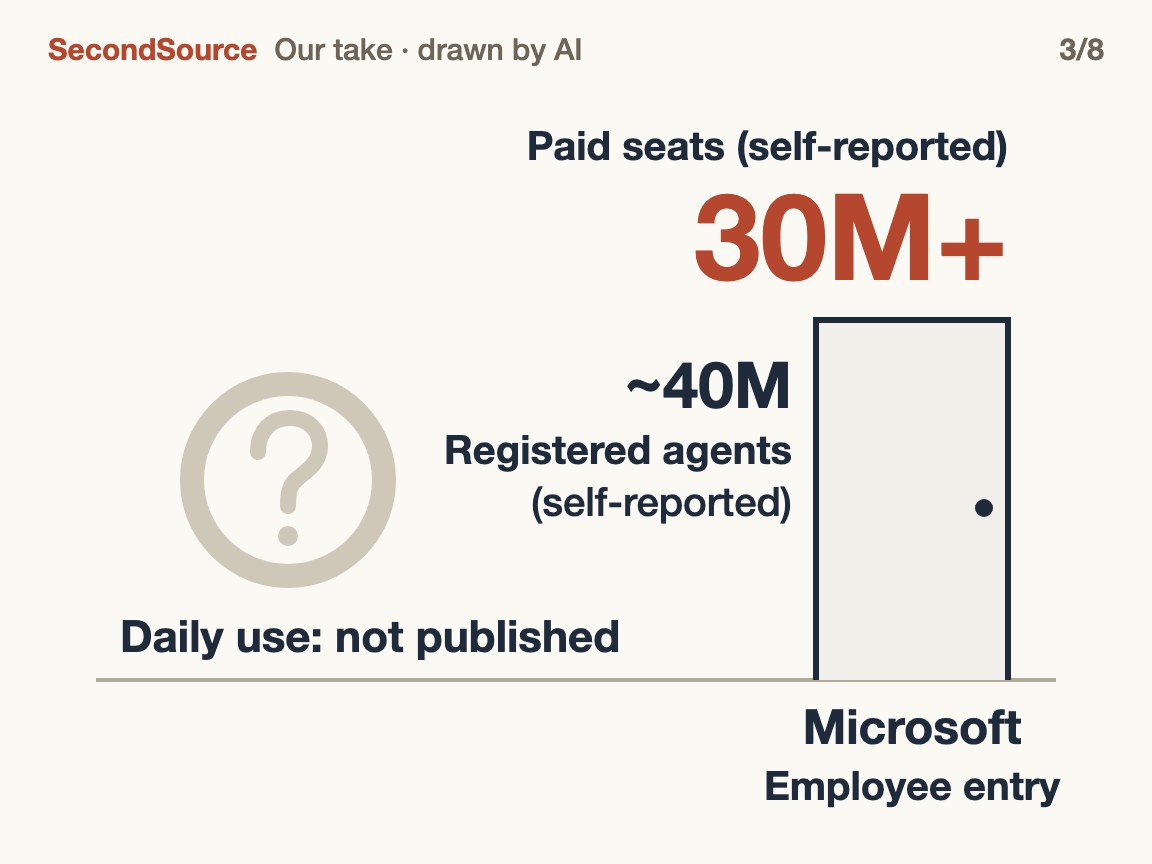
The penetration Polu talked about is a figure the suite makers had not published as of 2026. What is public is seat counts and registration counts.
First, the assistants. On Microsoft's July 2026 earnings call, CEO Satya Nadella said paid Microsoft 365 Copilot seats had passed 30 million. A seat is a licence a company buys for one employee. Google said in February 2026 that Gemini Enterprise, its AI entry point for businesses, had sold more than 8 million paid seats. These seats show that the employee entry point is concentrated with the suite makers. A paid seat is not the same as the share of employees using the tool every day. Both companies' figures are self-reported.
Next, the agents employees build themselves. Agent 365 is Microsoft's console where a company registers, manages and monitors its internal agents. Microsoft said in July 2026 that two months after launch, tens of thousands of companies had registered nearly 40 million agents on Agent 365. A registration count is the number of agents companies have listed on the console, not how much they are used. When Google launched Gemini Enterprise in October 2025, it promoted the idea that employees in any department could assemble agents without writing code. For this category there are only registration counts and vendors' own descriptions, no usage share.
How this report relates to the trend above: the tree is a trend SecondSource tracks. Business AI has moved step by step from chat assistants toward agents that work across tools on a person's behalf. This report adds one point: the step where employees build their own agents is being taken over by the suite makers.
Four: Independent horizontal platforms are still growing, but they don't own the entry point
The side with no entry point is growing too. Dust says more than 3,000 organisations use it and more than 300,000 agents run on its platform. Dust also says 70% of customers' employees use it each week, against its self-reported 60% to 70% in 2024, and that it lost no customers in 2025. Sifted, a European tech outlet, reports that Dust's annual recurring revenue passed US$20 million in 2026. Annual recurring revenue, or ARR, is current subscriptions converted to a yearly figure.
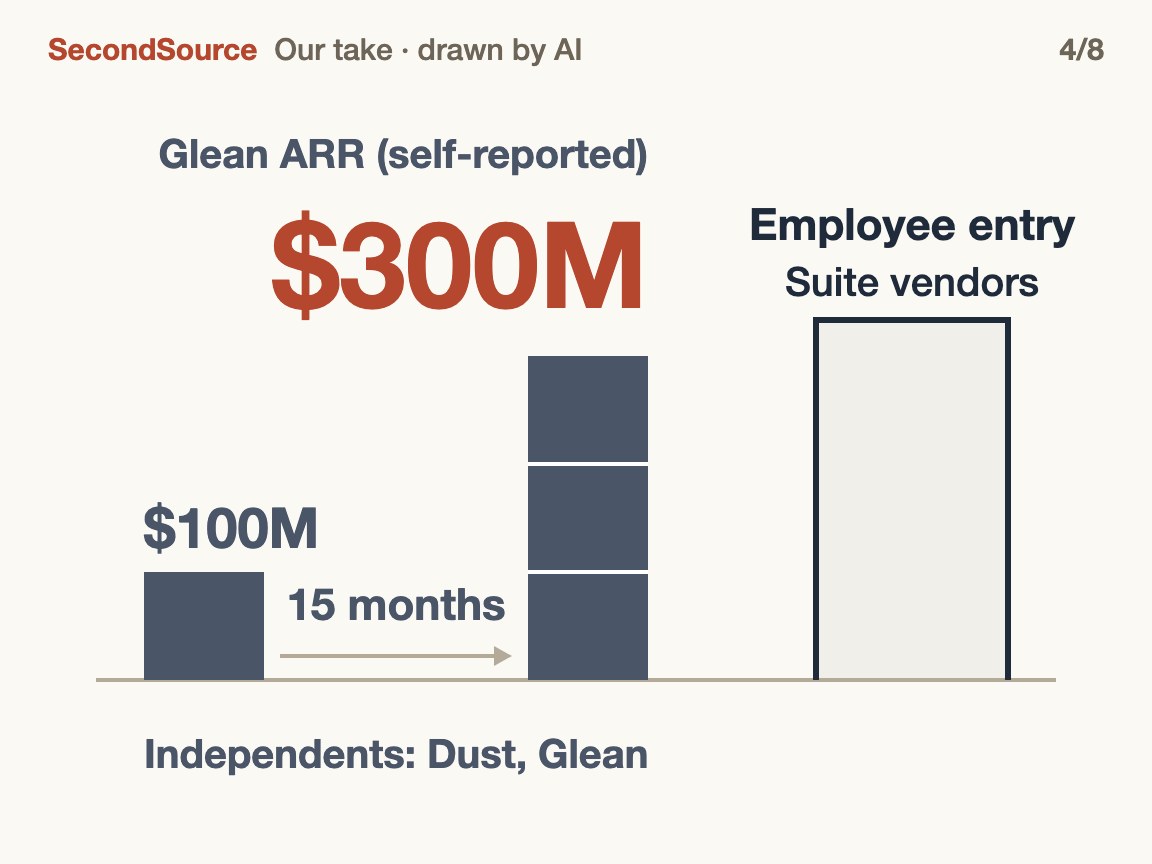
Glean started in search across a company's internal documents and later added agents. On May 28, 2026, Glean announced ARR of US$300 million. Glean took only 15 months to go from US$100 million to US$300 million.
The gap is the entry point. The office software and chat windows employees already use belong to neither Dust nor Glean. Both companies have to get employees to open one more tool.
Five: The integration moat has moved
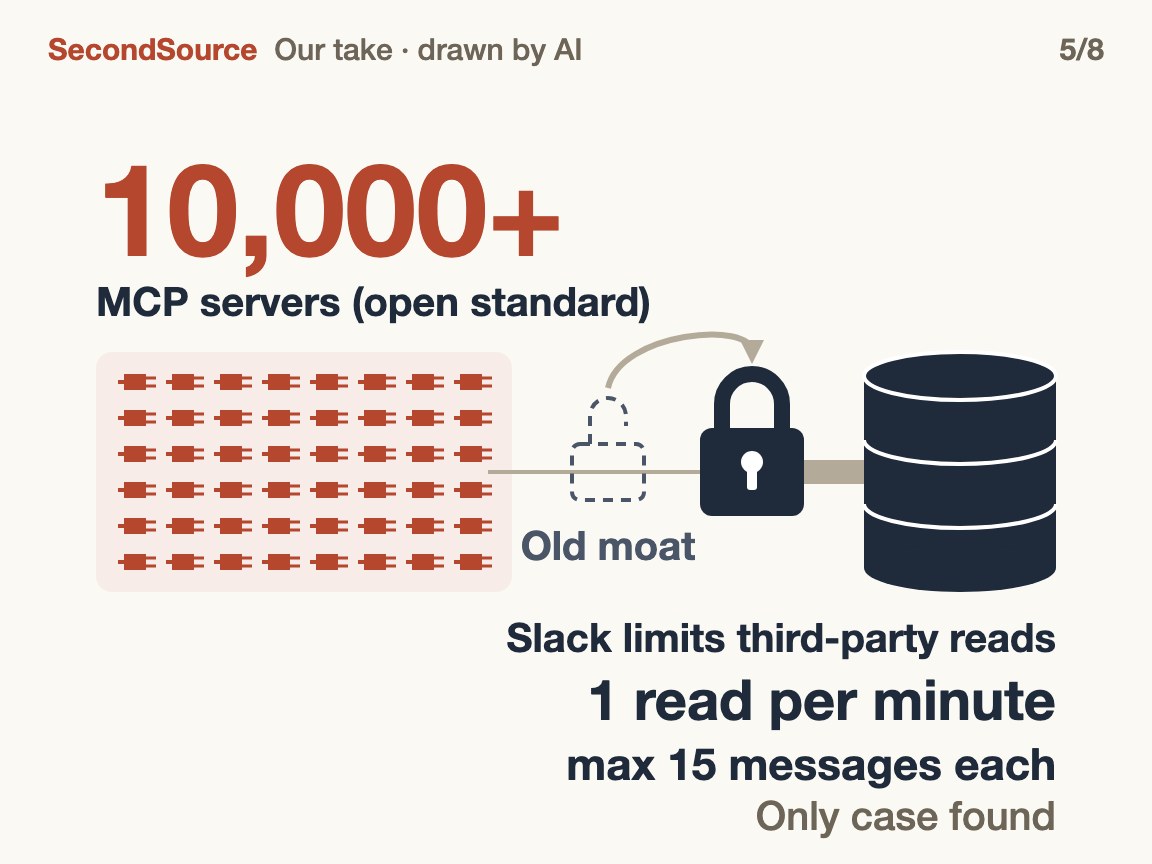
In 2024, Polu said that connecting agents to data in many different formats, such as Notion and Slack, was hard and tedious work, and that doing it well was a moat. Two years later, two developments have changed that from opposite ends.
The first made connecting cheap. MCP, short for Model Context Protocol, is an open standard Anthropic introduced in 2024 for connecting AI to outside systems. MCP is like a standard plug shape. Anyone can connect with the same plug, so that step gets cheaper. Once plugged in, organising the data and deciding who can read what still take separate work. Anthropic said in December 2025 that more than 10,000 public MCP servers existed, and that ChatGPT, Gemini and Microsoft Copilot had all adopted the standard.
From the other end, at least one case made getting the data harder. Slack is Salesforce's workplace messaging software. In May 2025, Slack capped third-party apps not listed on its official marketplace, agents and other apps alike. Such an app may read messages once a minute, at most 15 messages each time. According to Reuters, Glean wrote to customers that this would hamper their use of the business AI platform of their choice to read their own data. This is a single case. It is not enough to say data owners in general are tightening access.
Our read: the moat has moved from being able to connect to the side that holds the data and the permissions. The entry-point owners are selling that layer too. Microsoft's Agent 365 is one example. A feature from Anthropic that lets administrators restrict each connector's permissions one by one is another.
Six: Vertical companies weren't swallowed; Sierra charges by results and moves into the entry points
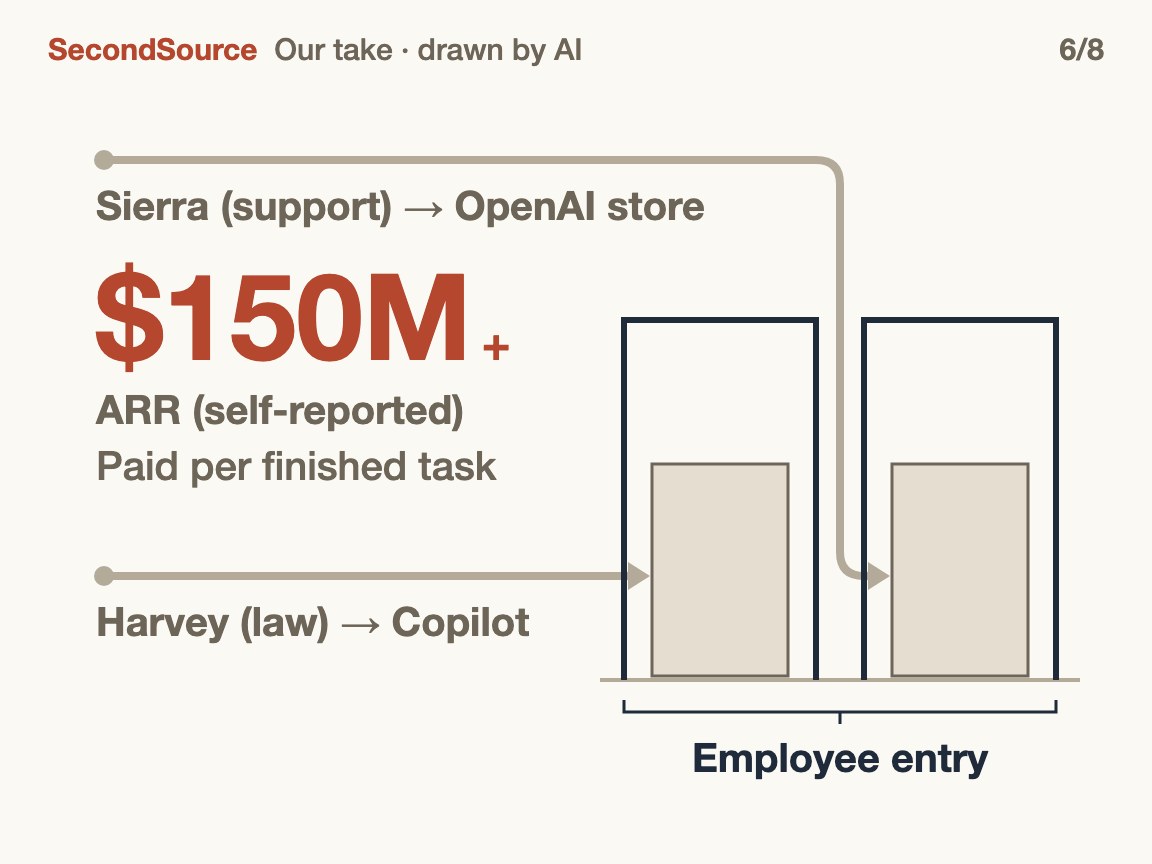
Sierra reached US$100 million in ARR in seven quarters and passed US$150 million in February 2026. Sierra charges for completed work, not a monthly fee. Harvey says 80% of the 100 highest-revenue US law firms use it. Harvey has not published its ARR.
Vertical companies are also moving into the horizontal entry points. In June 2026, Harvey announced that lawyers can call up Harvey directly inside Microsoft 365 Copilot (Harvey). In September 2026, Sierra became a launch partner of OpenAI's new marketplace. Companies can buy Sierra with purchasing budgets they have already committed to OpenAI.
Our read: both companies chose to borrow an entry point rather than fight its owners head-on.
Seven: Back to the 2024 question, horizontal was not a bad bet, but the money flows to whoever owns the entry point
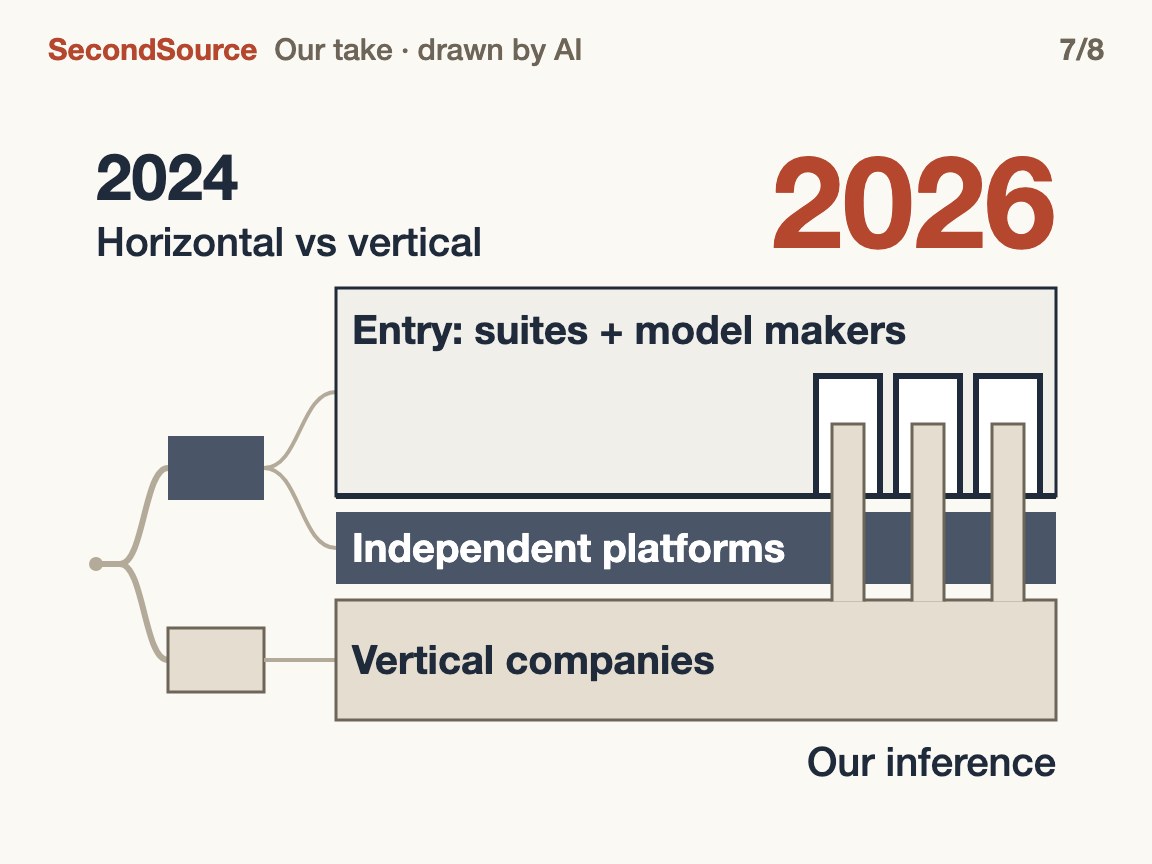
The 2024 split between horizontal and vertical now reads better as three positions, sorted by distance from the employee's entry point.
Owners of the entry point take most horizontal spending (sections two and three). They also sell tools that govern what agents are allowed to do (section five). Borrowers of the entry point are the vertical companies. They charge by results and put their products inside the owners' software and marketplaces (section six). Independent horizontal platforms own no entry point, and their business is growing (section four). Yet the whole category Menlo classes as agent platforms, Salesforce's Agentforce included, is less than a tenth of horizontal spending (section two). Independent platforms alone would be smaller still.
Back to the opening question. Horizontal versus vertical produced no winner. What separates the players is whether they own the entry point. In 2024 Crivello predicted many vertical agents plus a few very large horizontal ones. The shape came out roughly right. But the very large horizontal players turned out to be the companies that own the entry point, not start-ups like Lindy. Crivello's reason was that general tools win. The reason this report finds is entry points and permissions.
The three positions are SecondSource's inference. The evidence is not yet enough to say who will win.
Eight: What this changes, and for whom
- Independent horizontal platforms with no entry point: MCP has evened out the advantage of having the most connectors. What an independent platform can offer and a suite maker struggles to offer is neutrality. A company that uses both Microsoft and Google software could run a single agent platform. No public reading yet shows whether buyers will pay for that.
- Vertical companies borrowing the entry point: their sales channels are turning into the entry points and marketplaces of the suite makers and model companies. For those that charge by results, as Sierra does, gross margin depends on the model cost of each completed job.
Our call
Over the next two years, the suite makers and model companies that own the entry point will still take most horizontal agent spending. Whether independent horizontal platforms break out depends on whether buyers will pay for neutrality across Microsoft and Google.
Readings to watch next
Microsoft's paid Copilot seats and Agent 365 registrations on its next earnings call, and whether Microsoft publishes an active-use share for the first time. The next ARR figures from Dust and Glean.
What would prove this wrong
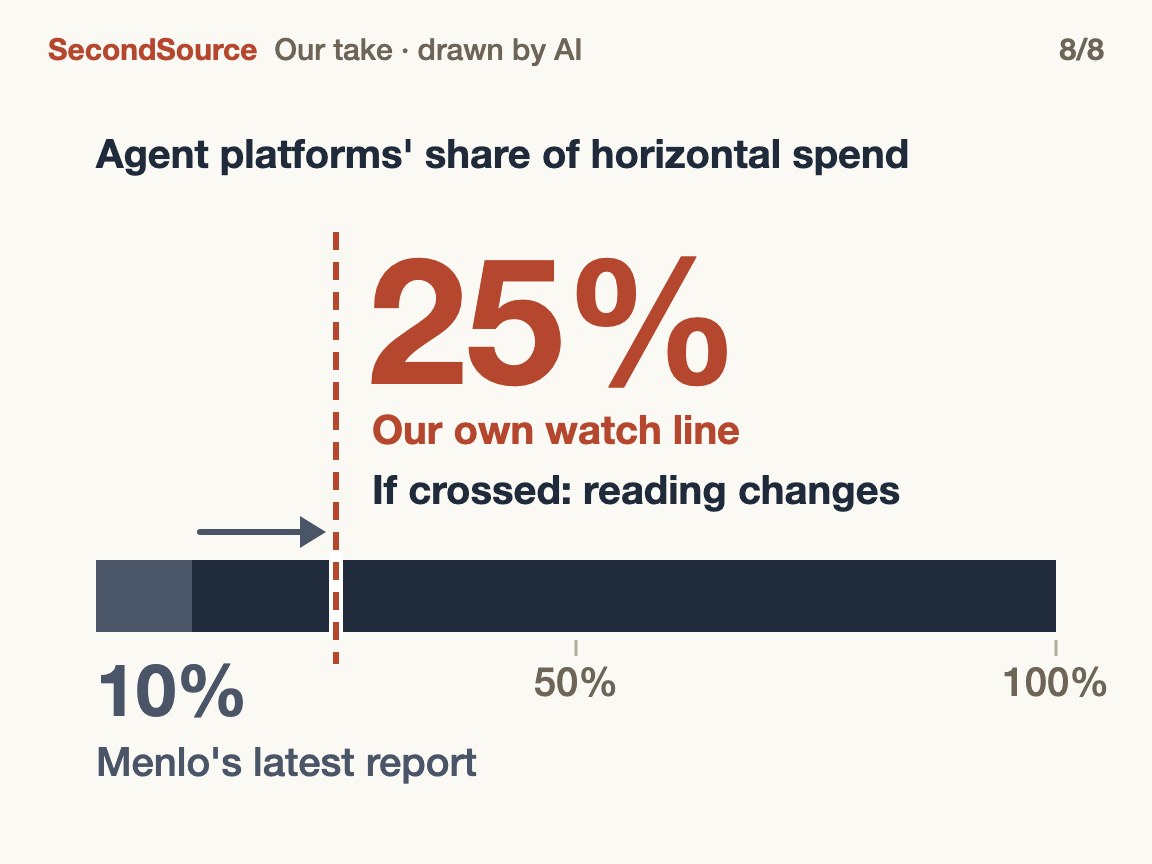
1. Within 30 days of Menlo Ventures' 2026 annual report: if agent platforms reach 25% or more of horizontal AI spending (Menlo's 2025 report puts them at 10%; the arithmetic is in the appendix), sections two and seven need rewriting. The 25% line is SecondSource's own watch line. A rise of two and a half times is too large to read as survey error.
2. By December 31, 2027: if any independent horizontal platform reports ARR above US$1 billion, the three-position reading in section seven needs narrowing. The US$1 billion line is SecondSource's own watch line.
3. By December 31, 2027: if Microsoft or Google announces it is dropping its built-in agent-building features, section three needs rewriting. If either announces a revenue-sharing partnership with an independent horizontal platform, section seven needs rewriting.
Appendix: where the numbers come from
SecondSource's calculations
- Agent platforms as a share of the application layer: US$750 million ÷ US$19 billion ≈ 3.9%, about 4%.
- The two categories sold by job or by industry: departmental US$7.3 billion + vertical-industry US$3.5 billion = US$10.8 billion.
- Assistants (Menlo's term: copilots) as a share of horizontal: 86% in the report (US$7.2 billion ÷ US$8.4 billion ≈ 85.7%, consistent with the report).
- Agent platforms as a share of horizontal: 10% in the report. By dollar amounts, US$750 million ÷ US$8.4 billion ≈ 8.9%, about 9%. The report does not explain the difference.
- Agent platforms against assistants: US$750 million ÷ US$7.2 billion ≈ 0.10, about one tenth.
Measurement notes
- Menlo's categories are horizontal, departmental and vertical-industry. The "vertical" that Polu and Taylor talked about covers both departmental tools (such as Sierra's customer service) and vertical-industry tools (such as Harvey's legal work). Together the two come to US$10.8 billion, more than horizontal's US$8.4 billion. But the largest departmental slice is coding tools at US$4 billion, which are a different kind of product from Sierra or Harvey. So the total does not show vertical agents earning more than horizontal ones.
- Microsoft's 30 million is paid seats, Google's 8 million is paid seats sold, and Dust's 70% is a weekly active share. These are three different measures and cannot be added, divided or ranked against each other. Dust has not published its user count.
- Menlo classifies by product type, not by use. Its categories cannot measure total spending on agents that employees build themselves.
- Each company defines ARR differently. Salesforce widened its definition of Agentforce ARR starting this quarter.
- Dust's ARR comes from Sifted's reporting.
Details left out of the main text
- Dust reported in 2024 that at its highest customer, 88% of all employees used it every day. Dust raised a US$40 million Series B in May 2026.
- Harvey raised US$550 million at a US$15.5 billion valuation in September 2026.
- Microsoft said in July 2026 that the number of business customers that had rolled Copilot out to most of their information workers grew nearly 75% in a quarter. Google says Gemini Enterprise has more than 2,800 customers.
- Anthropic said in April 2026 that most usage of Claude Cowork, its agent tool for office work, comes from outside engineering departments. That is Anthropic's own account. It gives no share and does not say how usage was measured.
- Salesforce said in August 2026 that Agentforce ARR passed US$1.5 billion. Large software vendors also sell agents built for one job.
- In May 2025, Slack also tightened its rules on outside apps storing data. After the change, Salesforce's own agents read Slack data on looser terms than third-party apps. Public sources do not say whether that was Slack's motive.
- Harvey also became a plug-in for Microsoft's Copilot Cowork.
- In the same Menlo survey, 76% of AI uses were bought rather than built in-house. "Built in-house" here means built by the company's IT team, not agents employees build on a platform.
- According to Fortune, an August 2025 report from an MIT research team found that about 67% of AI projects bought from specialist vendors succeeded, against about one third for projects built in-house.
- In June 2025, Gartner, the IT research and advisory firm, predicted that more than 40% of agent projects would be cancelled by the end of 2027 because of rising costs, unclear value or weak risk controls.
- Microsoft also said in July 2026 that its business model would move from charging per seat to charging per seat plus usage. Microsoft's Copilot Cowork already carries usage-based charges.
- Microsoft said in July 2026 that Dynamics, its business software for sales, finance and similar processes, lets agents reach data through MCP under one set of permissions and audit logs, and that more than 650,000 MCP actions had been created. That is Microsoft's term. It is a different measure from the count of public MCP servers, and the two cannot be compared.
- Sierra said in February 2026 that it had its first quarter with US$50 million in revenue, and that a quarter of its customers have annual revenue above US$10 billion.
- A customer-service agent Salesforce launched in June 2026 charges only when the agent resolves an issue from start to finish (Salesforce).
- Menlo estimates total corporate generative AI spending in 2025 at US$37 billion. The US$19 billion application layer is part of that.
- Within Menlo's vertical-industry category, healthcare is about US$1.5 billion and law US$650 million.
- In October, Sierra and Meta announced the Personal Agent Protocol, an open standard that lets a person's own agent prove its identity to a business. Partners include Shopify, Stripe and Walmart.
Other accounts
- MCP helped independent platforms: an open standard spares independent platforms from building every connector themselves, and the engineering saved can go elsewhere. On this reading, the moat got thinner for everyone rather than moving to the data owners.
- Vertical products will be absorbed by the models: CJ Hess of the consultancy Tenex argued on Latent Space in October 2026 that vertical products whose main pitch is only "one agent does one job for a person" will be absorbed as models improve, and that the durable ones are those that rewrite a workflow. On the day in February 2026 when Anthropic launched a legal plug-in for Cowork, shares of the legal-information company Thomson Reuters and others fell sharply. Several outlets reported it, with different figures for the drop. This report does not rely on that move.
Sources
The sources listed in the fact records this report cites, one per fact.
- Latent Space, 2024-11-11: Agents @ Work: Dust.tt — Stanislas Polu (Dust) on Latent Space
- Latent Space, 2024-11-15: Agents @ Work: Lindy.ai — Florent (Flo) Crivello on Latent Space
- Stratechery, 2025: An Interview with Sierra Founder and CEO Bret Taylor About AI Agents and Tech History Lessons
- Harvey Blog, 2026-06-16: Harvey's Legal Intelligence Now Lives Inside Microsoft 365
- Salesforce News, 2026-06-25: Salesforce Launches Agentforce Help Agent That Deploys in Minutes and Only Charges for Resolutions
Written from the same research and judgments as the Traditional Chinese edition. Sources are linked; we distinguish original documents from reporting and mark what we could not verify.