John Burn-Murdoch, chief data reporter at the Financial Times, and investor Gavin Baker read the same set of charts on the US post-pandemic productivity rebound and reach opposite conclusions.
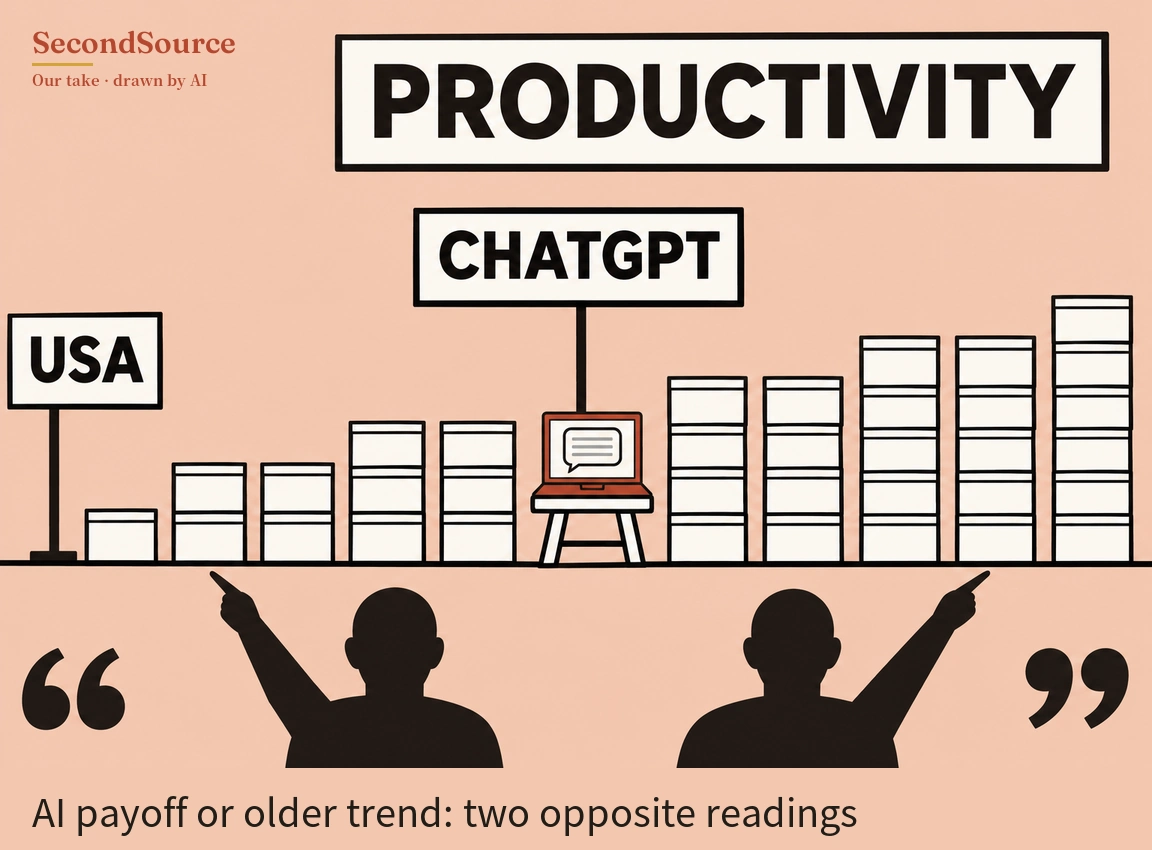
Anyone citing this rebound as proof that AI is paying off is relying on a reading the aggregate data can't yet settle. Baker's two supporting figures are relayed without their original sources. Burn-Murdoch wrote on November 1: "Lots of people say this chart shows AI is now showing up in the productivity data. But I made this chart to argue the opposite: a trend that pre-dates AI and only shows up in the US doesn't look like AI." (Burn-Murdoch, 2026-11-01) That passage is the first post of Burn-Murdoch's thread. Gavin Baker of Atreides Management, a technology investment firm, replied the same day that it is "hard for me to look at these charts from the FT, especially the first one, and not see some evidence of 'ROI on AI.'" Baker's reading is that the effect of post-pandemic overhiring faded first, and productivity resumed rising after ChatGPT came out (Baker, 2026-11-01). Baker cites the research firm EPB Research: in the three industries that have adopted AI most heavily, productivity growth went from 2.2% to 5%. Baker also says the US accounts for 72% of Anthropic's revenue, against about 50% at most application software companies. Baker uses those two shares to answer the point that the trend "only shows up in the US". The post doesn't say which period the 2.2% and 5% cover or which three industries they are. How we checked →
Source and checks
This item ran in the brief of Nov 2, 2026, alongside 4 other items. How we checked it, the quote checks and what was still missing that day are on that issue's How we checked page.
Cite this item
SecondSource (2026). "John Burn-Murdoch, chief data reporter at the Financial Times, and investor Gavin Baker read the same set of charts on the US post-pandemic productivity rebound and reach opposite conclusions.." https://secondsource.io/en/expert/2026-11-02-1/. Accessed access date.