Venture capitalist Tomasz Tunguz estimates the US will have to buy AI model output from data centers abroad as early as 2028, with the timing set by how many planned data centers can't get connected to power.
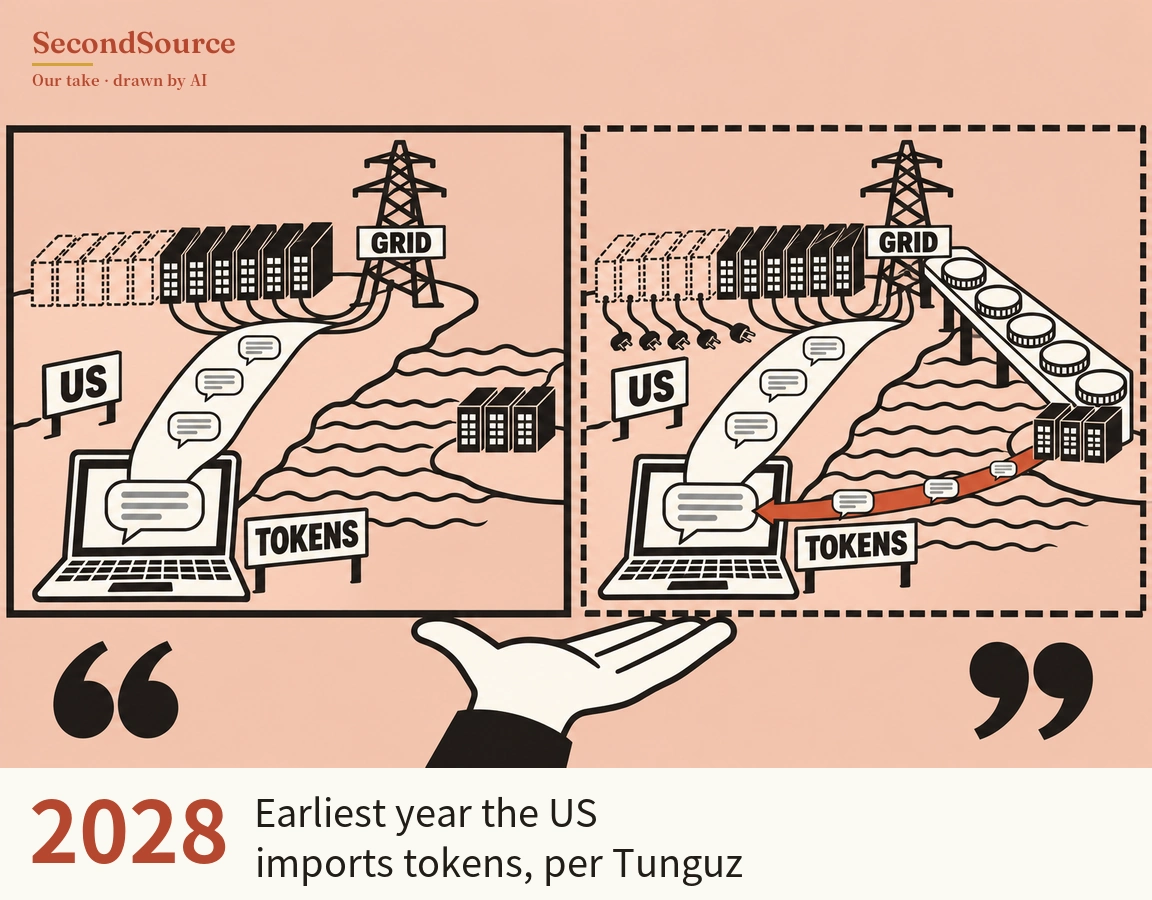
With the chip-efficiency gains Tunguz assumes, the year the gap opens depends mainly on grid connections and gas-turbine lead times. This is one analyst's estimate. Tunguz calls this state being a "net importer of tokens": part of the AI model output used in the US would have to be produced abroad. Tunguz's calculation has three inputs. Goldman Sachs estimates US data-center power capacity rising from 41 GW in 2026 to 66 GW in 2027. Tokens produced per watt grow about 2.9 times a year, a rate Tunguz combined from three new chips' gains over their previous generations; the post doesn't say how they were combined. Only 55% of planned US capacity comes online on time. Demand is assumed to grow 2.5 times a year. With 45% of planned projects unable to connect to power, the US has to import by 2028. If that share falls to 20%, the gap slips to 2029. Even if every planned project arrives on time, a gap appears in 2030. Tunguz also writes that electricity is only 5% of a GPU's hourly cost against 64% for capital recovery, so the cost of capital decides where compute sits (Tomasz Tunguz, 2026-11-09). Theory Ventures, where Tunguz works, invests in AI startups. How we checked →
Source and checks
This item ran in the brief of Nov 10, 2026, alongside 12 other items. How we checked it, the quote checks and what was still missing that day are on that issue's How we checked page.
Cite this item
SecondSource (2026). "Venture capitalist Tomasz Tunguz estimates the US will have to buy AI model output from data centers abroad as early as 2028, with the timing set by how many planned data centers can't get connected to power.." https://secondsource.io/en/expert/2026-11-10-2/. Accessed access date.