Looking back · SecondSource deep dive, October 21; rewritten October 27
Anthropic and shareholders absorb a compute shortfall first
If Anthropic's revenue can't keep up with its multiyear compute bills, Anthropic and its shareholders absorb the loss first, and the suppliers selling the compute come later. SecondSource's October 21 deep dive held that if revenue fell short, the only parties besides Anthropic that might book a loss were two suppliers. One was Broadcom. On June 9, Broadcom, Apollo and Blackstone announced a financing platform in which investors buy AI racks from Broadcom and lease them to Anthropic. Broadcom's report for the quarter ended August 2 says that if rent can't be paid for a time, "a customer" can borrow up to US$42 billion from Broadcom, and if the lease defaults, Broadcom compensates the investors by formula, about US$29 billion in the worst case. The quarterly report doesn't name the customer. The deep dive identified it as Anthropic from events after the quarter closed.
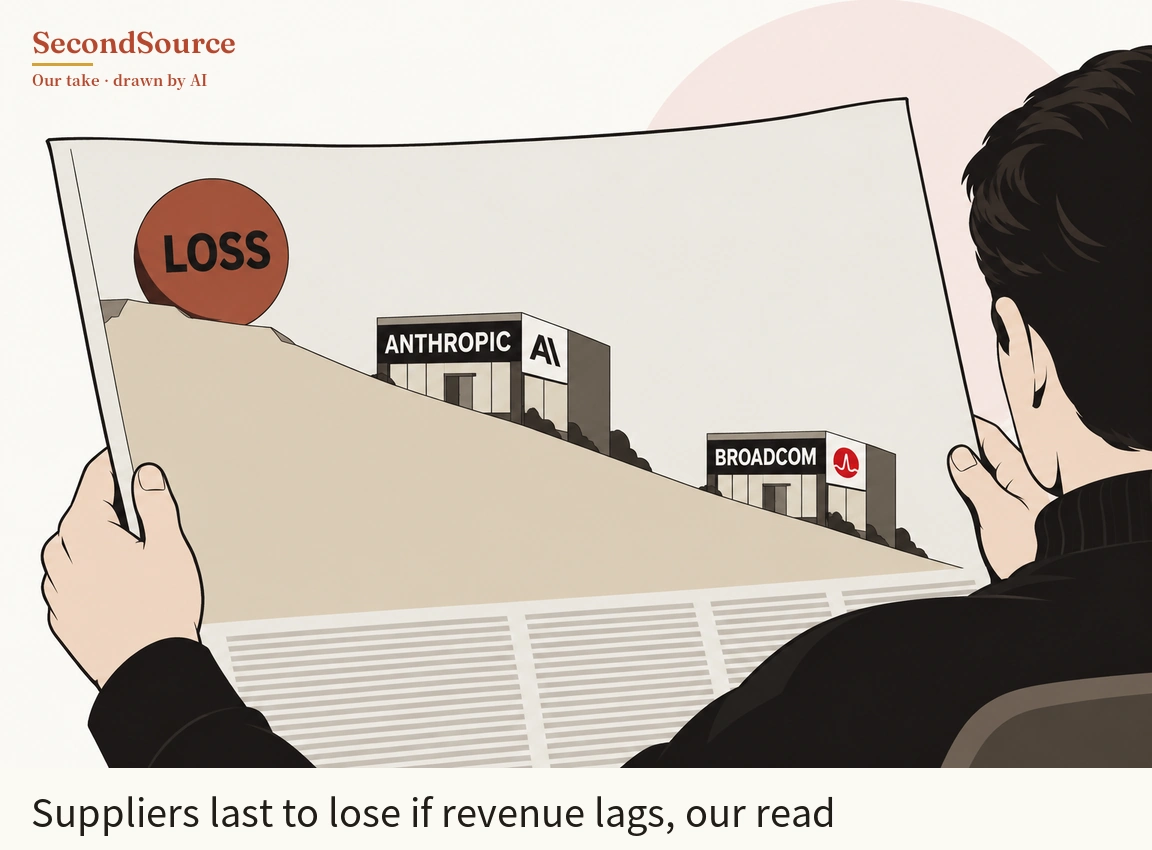
The other was Amazon, which holds Anthropic shares and booked large gains at the latest round's price. If the IPO price comes in below that, Amazon may have to give some of the gain back; this was the deep dive's inference.
The October 26 S-1 rewrote that order. The minimums on three cloud contracts are owed even if the capacity goes unused, and the Broadcom rack leases can't be cancelled early, yet 80% of first-half revenue was usage-based. So Anthropic's cash covers any revenue shortfall first, and the emergency loans Broadcom and Google promised depend on revenue thresholds. SecondSource's October 27 deep dive therefore changed to: at least while cash plus revenue can pay the bills, the cost lands first on Anthropic's shareholders; Broadcom and Amazon are still on the list but further back, and Google has joined it.
Today's main-line cash flow statement is the cash side of this thread: Anthropic's operations now bring in cash, and the open question is contract commitments and future usage. To gauge chip and cloud suppliers' exposure to a single model company, keep two things apart. A customer buying less does not become a loss on a supplier's books. Money a supplier advances to the customer, or guarantees on its behalf, is what turns into a loss. If the amended S-1 shows suppliers lending regardless of revenue when revenue falls, this order has to be taken back (full deep dive, October 21; full deep dive, October 27). How we checked →
Source and checks
This item ran in the brief of Oct 28, 2026, alongside 15 other items. How we checked it, the quote checks and what was still missing that day are on that issue's How we checked page.
Cite this item
SecondSource (2026). "Anthropic and shareholders absorb a compute shortfall first." https://secondsource.io/en/news/2026-10-28-4/. Accessed access date.