Analyst Sravan Kundojjala estimates the top five chip-equipment makers' third-quarter DRAM equipment revenue rose 80% year on year, and Tokyo Electron raised its forecast for next year's equipment market
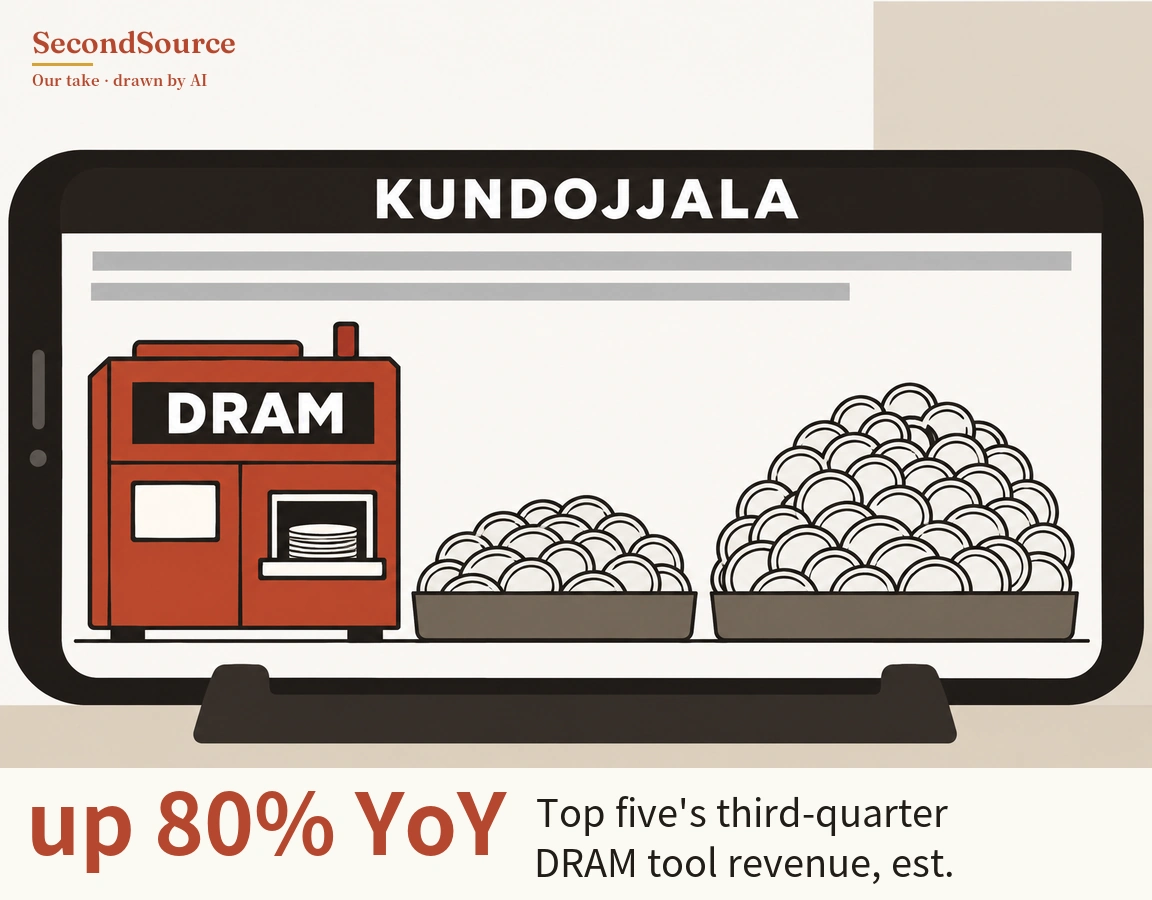
Semiconductor analyst Sravan Kundojjala estimated on November 1 that the top five semiconductor equipment makers' DRAM equipment revenue in the third quarter was 80% higher than a year earlier. Our inference: memory chips are already short, and tools sold now add chips only after installation and ramp-up, so memory buyers such as PC makers should not expect the shortage to ease right away.
The five makers' combined third-quarter figure is a record and shows no sign of slowing, Kundojjala writes. At an annual rate, which is the third quarter times four, that comes to more than US$35 billion (Kundojjala, 2026-11-01).
Tokyo Electron, Japan's largest semiconductor equipment maker, lifted the industry's spending outlook as well. Its October 30 earnings presentation raised its forecast for next year's global wafer fab equipment market from more than US$190 billion in July to more than US$210 billion (relayed by Kundojjala; relayed by the German financial news site ad-hoc-news). That forecast covers equipment for logic chips as well as memory.
NAND flash memory is tight as well. According to Kundojjala, NAND flash maker Kioxia's capacity for 2027 is already sold out, and more than half of its 2028 bit shipments are locked in by long-term agreements (Kundojjala, 2026-10-30). PC buyers are feeling it too. SecondSource reported on November 1 that Intel's CFO attributed weak PC sales to memory shortages and limited IT budgets.
Not proven yet: the 80% is Kundojjala's estimate alone How we checked →
Next to watch: DRAM contract prices in the first half of 2027, and whether Tokyo Electron raises its equipment market forecast again at its next earnings early next year. If DRAM contract prices fall for two straight quarters in the first half of next year, memory is loosening sooner than this inference assumes.
Answer check: On September 13, SecondSource asked whether Google would sign an outside TPU long-term deal naming the customer and the term; TPUs are Google's in-house AI chips. Anthropic's October 26 S-1 listing filing states that Anthropic will buy TPU compute from Google and other vendors from 2028 to 2031, so this call came true. Anthropic had already announced a similar long-term deal in October 2025, so this result doesn't show that outside sales of Google TPUs began only after September. Card →
Answer check: On September 6, SecondSource set a test: by November 1, would OpenAI, Anthropic or Google DeepMind publish the layer count of a current flagship model? Geoffrey Irving argues for letting independent reviewers inspect model architecture now, and SecondSource took a published layer count, the most basic number in a model's architecture, as the minimum bar for whether that is feasible. None of the three companies' system cards or model cards published by November 1 gives a layer count, so this call missed. Anthropic's October 15 statement also says that METR, the organization that runs external model evaluations for Anthropic, gets access that doesn't include model architecture information. Card →
Source and checks
This item ran in the brief of Nov 2, 2026, alongside 4 other items. How we checked it, the quote checks and what was still missing that day are on that issue's How we checked page.
Cite this item
SecondSource (2026). "Analyst Sravan Kundojjala estimates the top five chip-equipment makers' third-quarter DRAM equipment revenue rose 80% year on year, and Tokyo Electron raised its forecast for next year's equipment market." https://secondsource.io/en/news/2026-11-02-2/. Accessed access date.