Venture investor Tomasz Tunguz estimates that 40% of gross profit across the AI value chain lands with applications, and the 28% for compute rental providers is before GPU depreciation
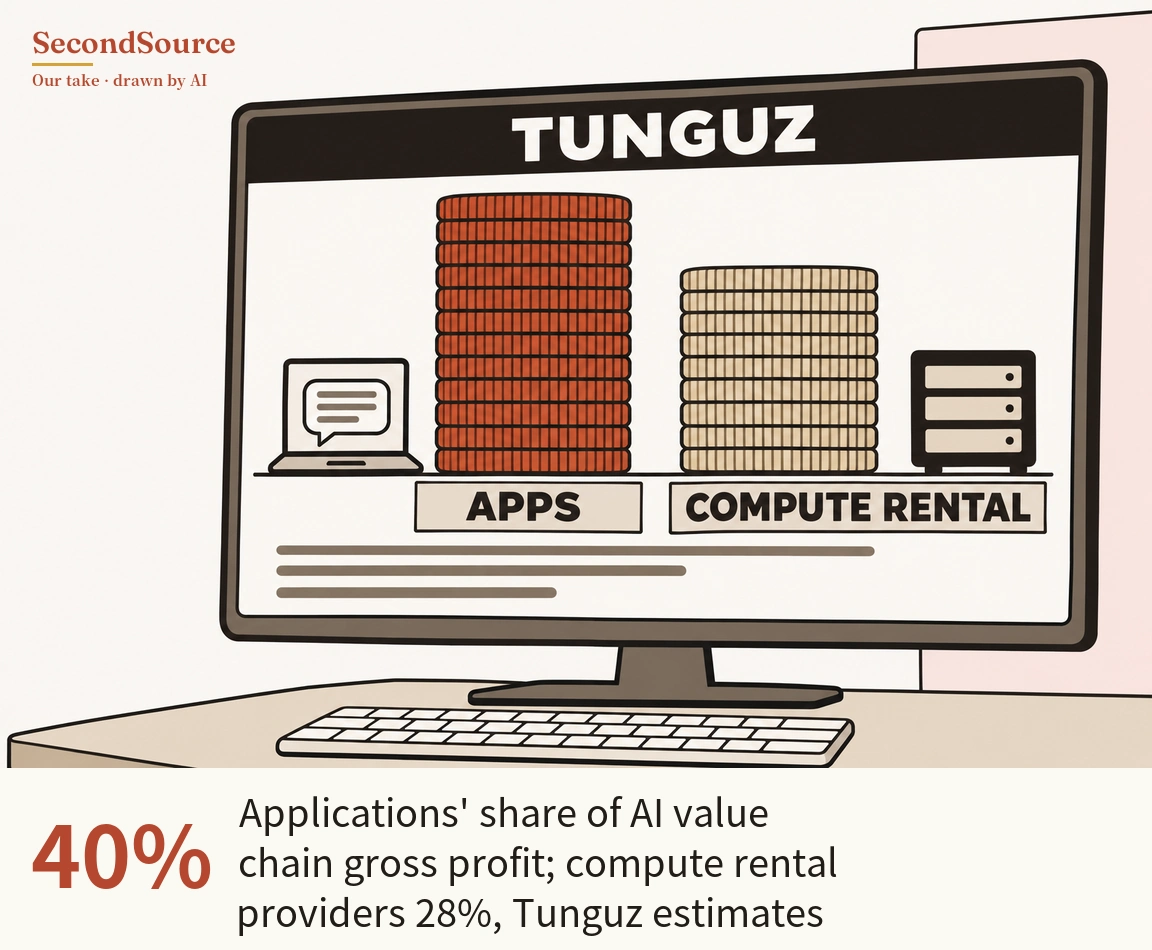
Tomasz Tunguz of the venture firm Theory Ventures published a model on November 11 that puts gross profit across five layers of the AI value chain on one unit (Tomasz Tunguz, 2026-11-11). Tunguz says who ends up paying for rising compute prices depends on whether apps can charge customers more for better results. All five layers' figures are Tunguz's estimates.
Tunguz converts the revenue of five layers (power plants, data centers, compute rental providers, inference providers and applications) into US dollars per watt per year. Tunguz first assumes the application layer's own gross margin is 40%, an assumption rather than a measurement. Under that assumption, applications take 40% of the chain's total gross profit, compute rental providers 28%, inference providers 24%, and power and data centers 8% combined. The two 40% figures are unrelated: one is the assumed application gross margin, the other is applications' share of the chain's gross profit.
The 28% for compute rental providers is before GPU depreciation, and Tunguz's estimate of what remains after it differs from SecondSource's conversion of CoreWeave's press release. Tunguz works from CoreWeave, a cloud provider that rents out GPUs: revenue of about US$9.15 per watt per year, and GPU depreciation estimated at US$6 to US$8 per watt per year. Converting the depreciation and amortization in CoreWeave's third-quarter press release gives about US$4.7 per watt per year, below the model's figure (our calculation; CoreWeave third-quarter press release, 2026-11-10). The press release figure covers all depreciation and amortization on the company's books, while Tunguz estimates GPU depreciation only. The two are calculated differently, so neither shows the other is wrong.
Tunguz's conclusion is conditional. Tunguz writes that if applications can charge customers more because they work better, rising compute prices can pass all the way through; if not, the compute rental, inference and application layers will compete for one fixed pool of gross profit.
Not proven yet: CoreWeave CEO Intrator's new contract pricing is relayed only by Tunguz How we checked →
Tunguz's own numbers don't add up at the depreciation step. The US$9.15 per watt per year is CoreWeave's third-quarter revenue of US$3.661 billion times four, divided by about 1.6GW, Tunguz's estimate of average active power during the period; CoreWeave discloses more than 1.7GW of active power at quarter end. GW here is power capacity, not generation. Our calculation: third-quarter depreciation and amortization of US$1.889 billion times four, divided by 1.6GW, is about US$4.7 per watt per year. Tunguz writes that after depreciation CoreWeave's gross profit is US$0 to US$2 per watt per year. Per the footnote, US$9.15 of revenue minus about US$2 for data centers and power leaves about US$7 before depreciation. Subtracting US$6 to US$8 gives minus US$1 to plus US$1. That doesn't match Tunguz's US$0 to US$2.
Tunguz also cites CoreWeave CEO Michael Intrator saying on the earnings call that pricing on new four- to five-year contracts is moving toward US$20 million to US$25 million per megawatt, about US$20 to US$25 per watt. Tunguz says that is more than twice CoreWeave's current figure of about US$9. The first half of the sentence Tunguz cites also mentions "more than US$40 million per megawatt per year," so that sentence alone can't settle whether new pricing is rising from a low level or falling from a high one. The remark is Tunguz's relay and hasn't been checked against the call transcript; CoreWeave's press release gives no per-megawatt price at all.
Next to watch: revenue and active power in CoreWeave's next quarterly report, and whether the average price they imply moves toward the new contract pricing.
Source and checks
This item ran in the brief of Nov 12, 2026, alongside 16 other items. How we checked it, the quote checks and what was still missing that day are on that issue's How we checked page.
Cite this item
SecondSource (2026). "Venture investor Tomasz Tunguz estimates that 40% of gross profit across the AI value chain lands with applications, and the 28% for compute rental providers is before GPU depreciation." https://secondsource.io/en/news/2026-11-12-4/. Accessed access date.