Deep Dive Oct 23, 2026
Will an AI overbuild end in telecom-style bankruptcies? AI's debt hasn't disappeared, only moved
This report crosses: telecom history, corporate credit and bond defaults, lease accounting, credit ratings and default insurance, GPU rental pricing. Primary documents read: 14.
Key takeaways
Around 2000, telecom companies borrowed heavily to lay far more fiber than anyone needed. In 2002, more than half of the world's defaulted corporate bonds were telecom bonds.
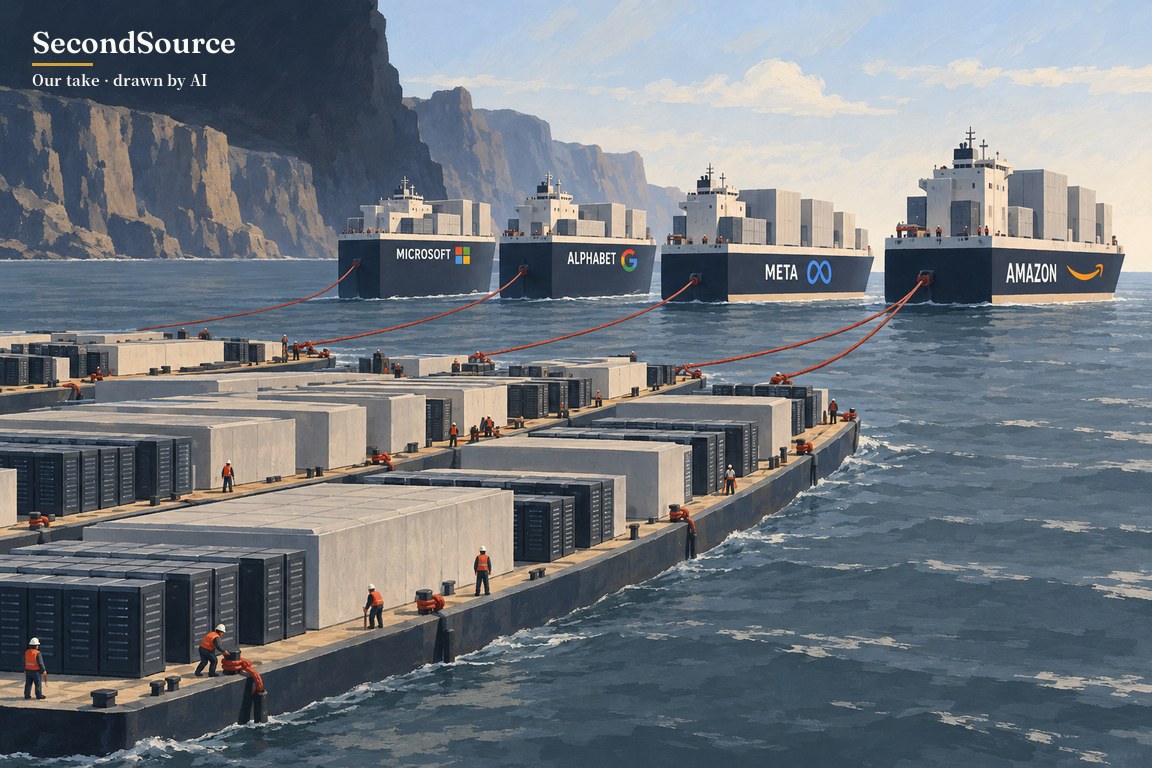
In July, SecondSource called it this way: AI data centers will also be overbuilt, but there will be no repeat of the bankruptcy wave. The reason was that the four biggest buyers nearly all held more cash than debt. The four are Microsoft, Alphabet (Google's parent), Meta and Amazon, called the hyperscalers below.
A fresh check changes that call. Microsoft and Alphabet still hold more cash than debt. Meta holds only slightly more. Amazon now owes more than it holds.
The debt has not disappeared either. Part of it has turned into data-center leases of ten-plus years, whose rent is a fixed bill every year. Part of it sits with the companies that build data centers and rent out compute for the four hyperscalers and OpenAI. Compute is the processing capacity that runs AI models.
So in a glut, the hyperscalers would earn less, and those builders and renters could fail to repay what they owe.
One: The 2023 call, a bankruptcy wave needs three things at once
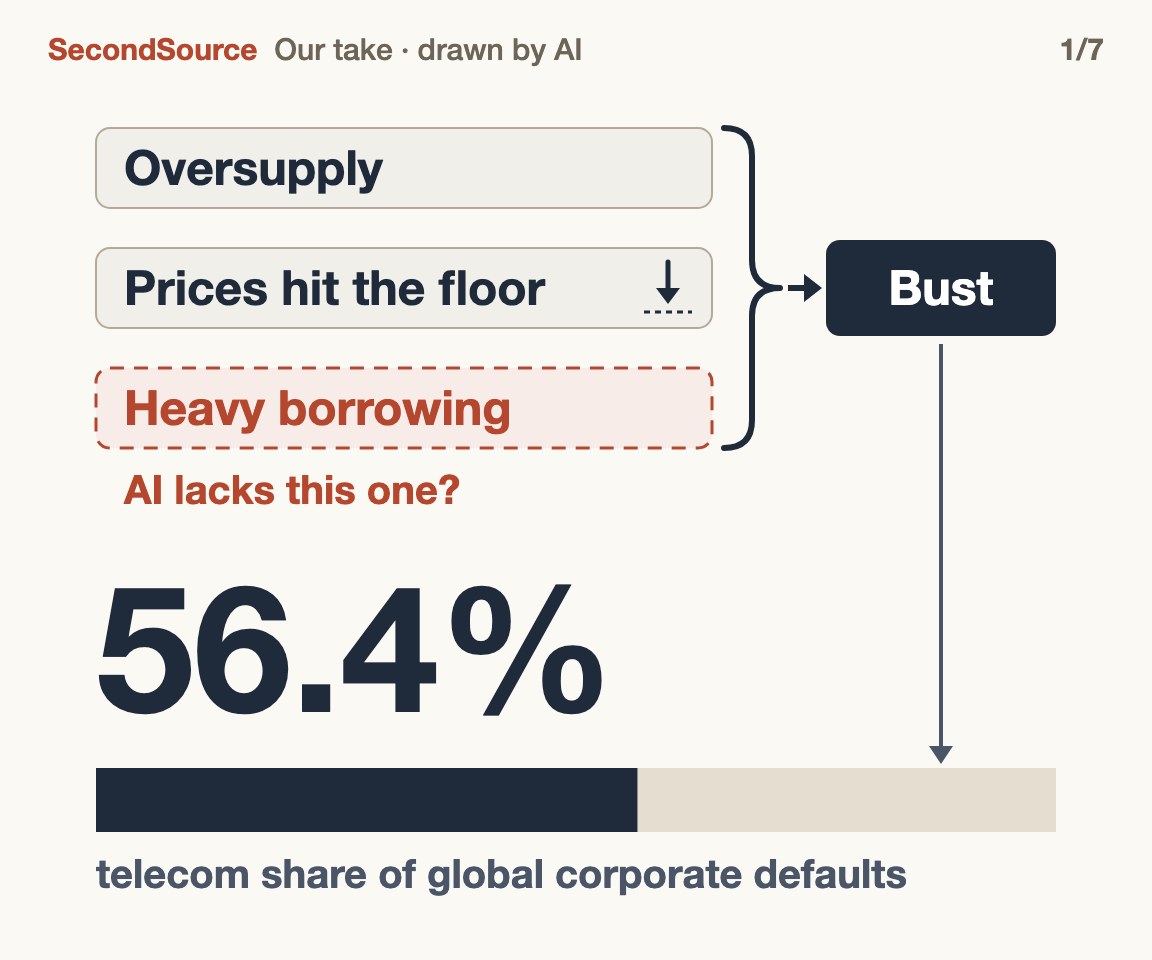
The July call drew on a 2023 analysis that broke telecom's ending into three conditions.
The first is oversupply. When something is scarce, everyone rushes to build, and the rush overshoots.
The second is prices falling to marginal cost. Marginal cost is what it costs to sell one more unit. Once fiber is in the ground, carrying a little more data costs almost nothing, so prices can slide toward zero. The analysis argued that for a company renting out GPUs, the chips that run AI models, one more rented hour costs mainly electricity. In AI terms, the second condition is GPU rental prices falling close to the power bill.
The third is high leverage, meaning a lot of borrowed money. When prices fall below what covers the interest, the borrowers go bankrupt.
The scale of telecom's wave is on record. A 2003 report from the Organisation for Economic Co-operation and Development (OECD), the research and policy body of the rich democracies, says: "Defaults on corporate bonds worldwide reached $163 billion in 2002, of which 56.4 per cent in the telecommunications sector." A corporate bond default is a company failing to repay borrowed money when due.
The 2023 analysis was an October 2023 essay by the analyst Doug O'Laughlin in Fabricated Knowledge. It reads: "Except for Amazon, almost none of the companies carry net debt." Net debt is debt minus cash. Without the third condition, the cost of a glut would be lower earnings, not unpaid debts. The question here is whether that premise still holds three years later.
Two: Telecom's bankruptcies were concentrated in one layer too
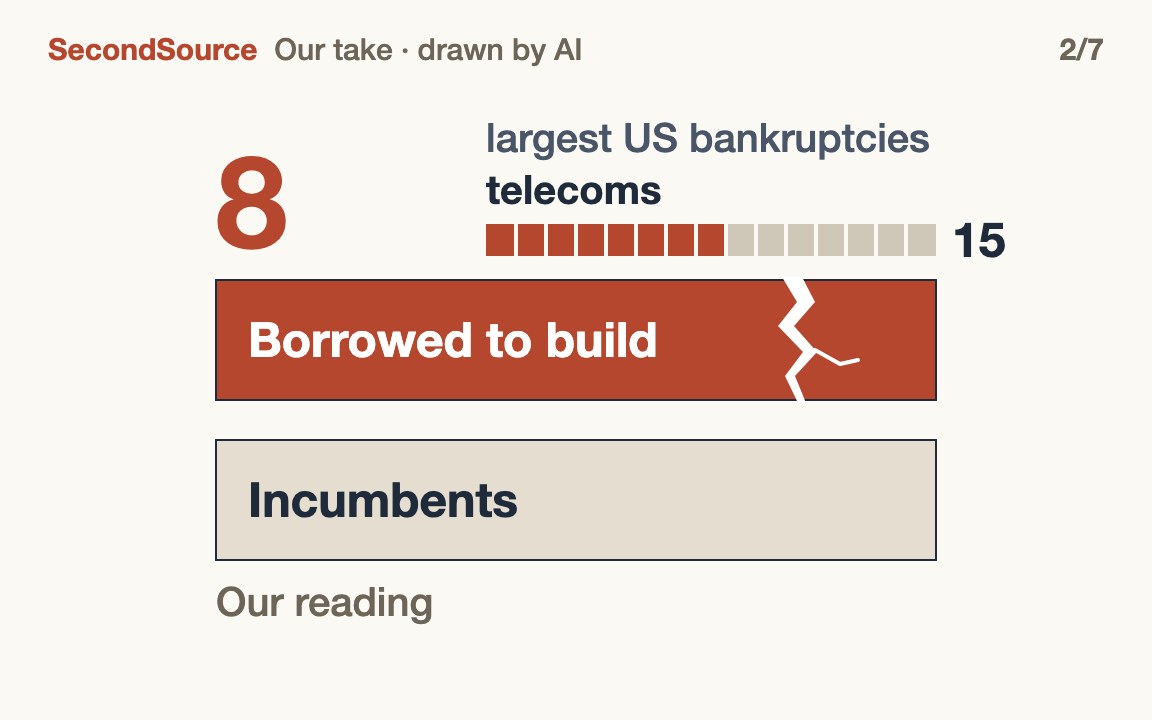
The OECD report lists the 15 largest US public-company bankruptcies of 2002. Eight were communications companies, WorldCom and Global Crossing among them (full list in the appendix). Most were companies that borrowed to lay new long-distance fiber or to break into local markets after the US opened telecom to competition in 1996. That grouping is SecondSource's reading of the list, not the OECD's. WorldCom also involved accounting fraud, documented in a US Securities and Exchange Commission report, so not every one of these failures came from borrowing too much.
The same report says the established carriers lost market share to the newcomers, yet "incumbents have generally been able to maintain or even increase revenues". The exception was Qwest, which had bought the established carrier US West (see the appendix).
So the whole industry did not go bankrupt together. Telecom split into two layers: the layer that borrowed to build new networks failed, and the established carriers survived. That is SecondSource's reading of the OECD report, and the report is the only primary source for it so far. Equipment makers upstream were hurt too: the OECD estimates US carriers cut capital spending by 47% in 2002, and equipment makers had to shrink.
Comparing AI's hyperscalers with the telecom industry as a whole therefore compares the layer that survived with the layer that failed.
Three: The hyperscalers have room left to borrow, but Meta's and Amazon's cushions are nearly gone
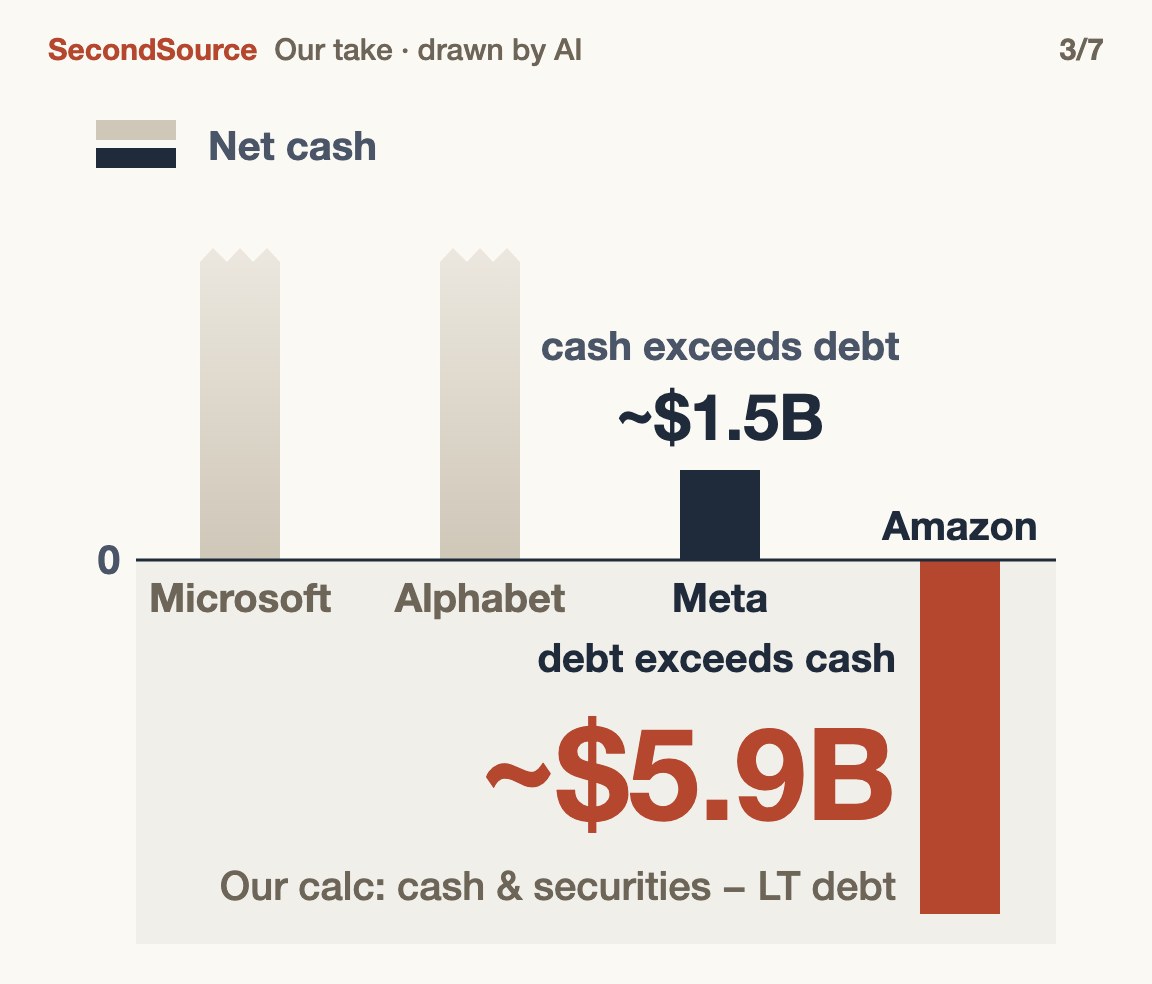
The figures come from each company's latest filing. Net cash here is cash and marketable securities minus long-term debt, leases excluded (our calculation).
- Microsoft (annual report): at the end of June 2026, US$76.8B in cash and short-term investments against US$46.1B of debt principal, for net cash of about US$30.7B.
- Alphabet (Q2 release): at the end of June, US$242.5B in cash and marketable securities against US$98.2B of long-term debt, up from US$46.5B six months earlier; net cash about US$144.3B.
- Meta (Q3 release): at the end of September, US$82.45B in cash and marketable securities against US$80.9B of long-term debt; net cash about US$1.5B. At the end of last year long-term debt was US$58.7B.
- Amazon (Q2 release): at the end of June, about US$123B in cash and marketable securities against US$128.9B of long-term debt, so debt exceeds cash by about US$5.9B. Six months earlier long-term debt was US$65.6B.
Free cash flow is cash from operations minus capital spending. Three of the four have already had one negative period, over different spans: Meta minus US$2.1B in the third quarter, Alphabet minus US$5.9B in the second quarter, Amazon minus US$7.6B over the 12 months to June. A single negative quarter can reflect the timing of capital spending and is not necessarily a trend.
FactSet, a financial data company, counted in July that four of five major cloud companies had total debt of about one times EBITDA or less (FactSet). EBITDA is earnings before interest, taxes, depreciation and amortization, a common gauge of how much a core business earns. The report does not list which five companies it counted.
Four: Debt-like fixed bills, the long leases
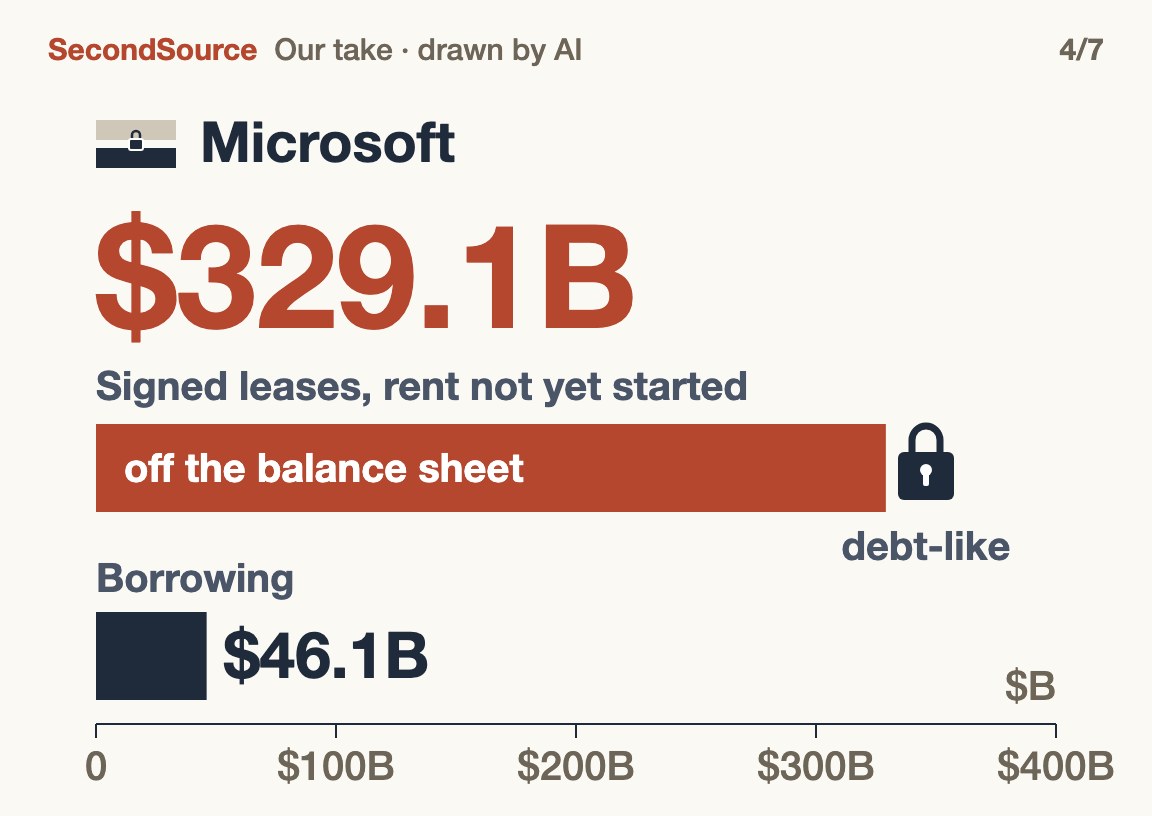
Besides borrowing, the hyperscalers sign data-center leases of ten years or more, and the developers borrow to build. A lease that is signed but has not yet reached the date when rent starts is called not yet commenced. Until then it does not appear on the balance sheet.
Microsoft's annual report for the year to June says there were US$329.1B of further leases, "primarily for datacenters", signed but not yet commenced. They commence between fiscal 2027 and fiscal 2033, and some take effect only once contract conditions are met. In the same report, Microsoft's borrowing principal is US$46.1B. Reading borrowing alone misses this block. (How the report's other table, with US$443.5B of leases in total, reconciles with the US$329.1B is in the appendix.)
The hyperscalers are not the only tenants. Oracle is not one of the four; this report places Oracle with the companies that rent out compute (section five). Oracle leases data centers from developers and rents the computing in them to customers such as OpenAI. At the end of August Oracle had a further US$288B of leases not yet commenced, almost all data centers, with terms of 15 to 19 years (Oracle 10-Q).
Meta took a different route. In October 2025 Meta moved about US$27B of development cost for its Hyperion campus in Louisiana into a joint venture (Meta announcement). Funds managed by Blue Owl, a private asset manager, own 80%, and Meta owns 20%. Part of the Blue Owl side's money was raised by issuing bonds. Meta leases the campus back and guarantees its residual value for the first 16 years. If the campus is worth less than the agreed estimate when the lease ends, Meta pays the difference, up to a cap. Of these arrangements, this one is closest to debt.
Leases can carry conditions and can be postponed, so they are more flexible than loans (an Oracle example is in the appendix). But once a lease commences, the rent is a fixed bill every year, and developers borrow against exactly these leases. That is why this report counts leases as debt-like spending.
Five: The compute-renting layer has grown telecom-style debt
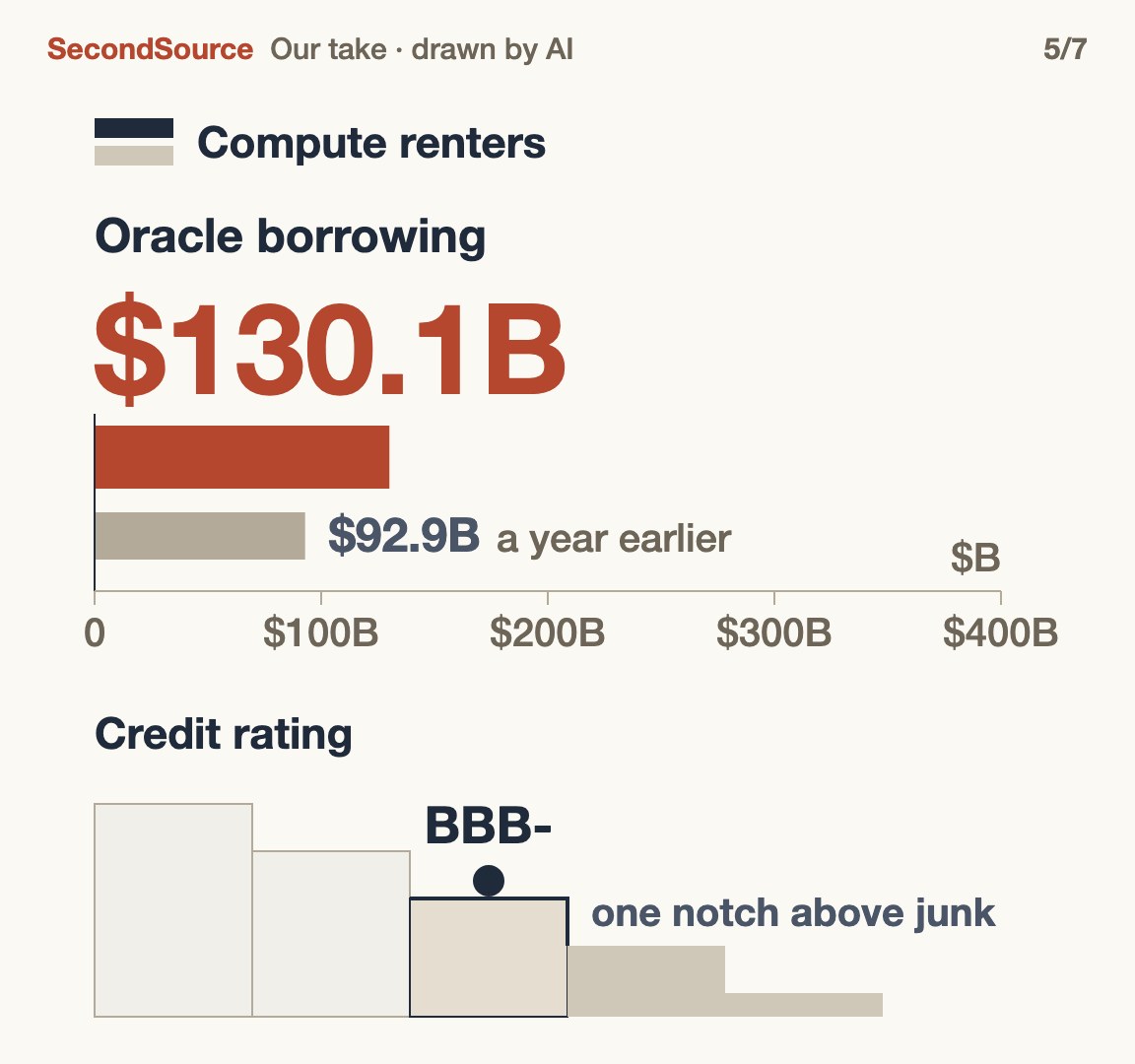
Oracle's borrowing principal, not counting the section-four leases, was US$130.1B at the end of May 2026, up from US$92.9B a year earlier (Oracle annual report). In the annual report's borrowing table, all of it sits with the Oracle parent company and none is secured by collateral. Creditors can rely only on Oracle's overall ability to repay.
In July the rating agency S&P Global cut Oracle's debt to BBB-, the lowest rung of investment grade (The Next Web). One more notch down is the high-risk tier commonly called junk.
Oracle has US$638B of contracts signed but not yet fulfilled, known as remaining performance obligations. According to market reports, S&P estimates about half of that comes from OpenAI.
A credit default swap (CDS) is insurance bought against a company defaulting; the higher the price, the more the market worries. GuruFocus reported that Oracle's five-year CDS rose to a record annual fee of 2.88 percentage points in mid-October (GuruFocus via Yahoo Finance).
CoreWeave, a company that specializes in renting out GPUs, had US$35.55B of borrowing principal at the end of June (CoreWeave 10-Q). US$10.6B falls due within 18 months, 1.9 times the US$5.5B of cash on hand that day. That is our calculation from adding up the maturity table in the quarterly report (method in the appendix). October market reports put CoreWeave's CDS above 10 percentage points a year.
This layer is built much like the telecom newcomers that failed. It borrows to build new capacity, and its main customers are few; Oracle's reliance on OpenAI is the clearest case. The interest rates and customer concentration of that earlier era have no figures here to set alongside.
Six: The second condition hasn't arrived; new rental prices are rising, and only spot prices for older chips are falling
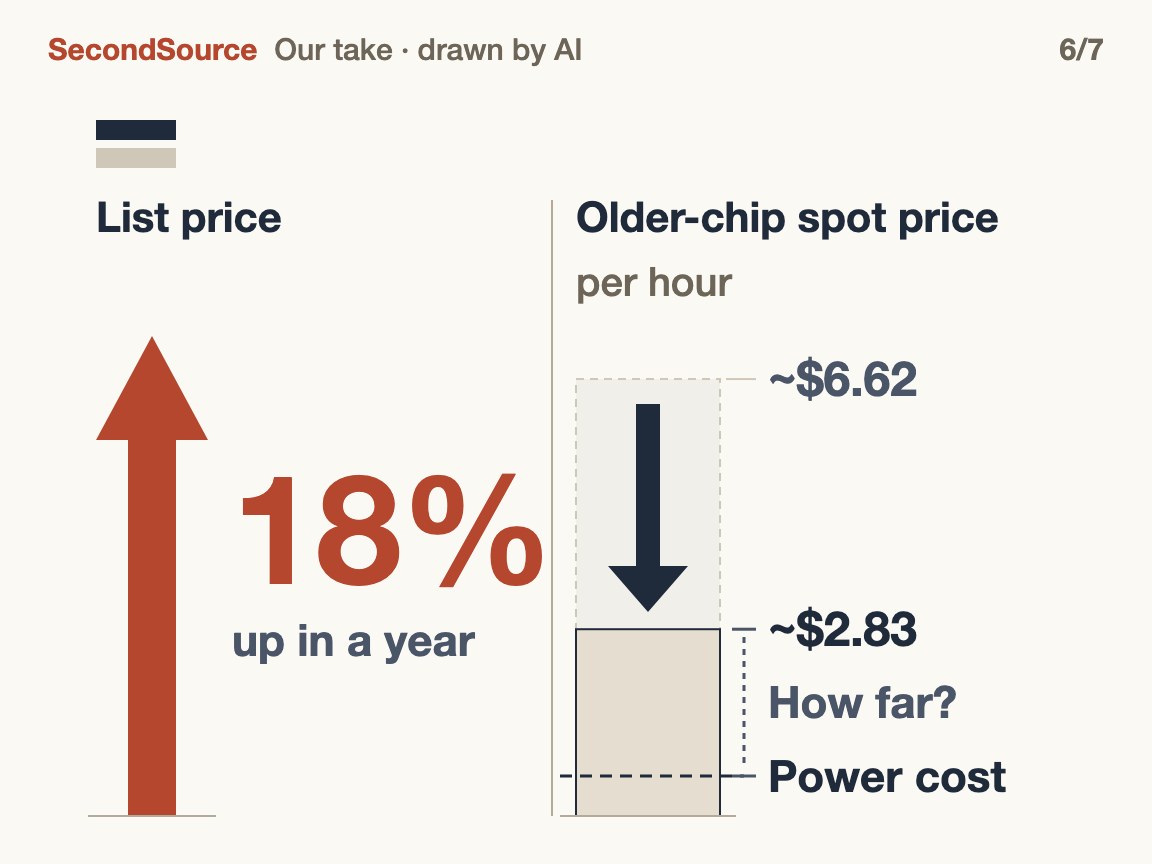
A list price is the hourly, stop-any-time price posted on a provider's website. A contract price is locked in for a set term. Both are still rising. SecondSource's October 18 deep dive gathered the readings. CoreWeave's chief financial officer said on the August earnings call that July's price changes included a rise of about 25%. The week of October 12, getdeploying, a website that tracks GPU rental prices, read list prices up 18% over a year.
The spot price is a different reading, and it moves the other way. The spot price is what a GPU rents for on the open market right now. The H100 is NVIDIA's previous-generation workhorse GPU. SemiAnalysis, a research firm that tracks the chip industry, compiles a rental price index. As relayed by a third party (intuitionlabs), the H100 spot price fell from about US$6.62 an hour at the end of 2023 to about US$2.83 in February 2026, with no newer reading since. How far that price sits above the cost of power can't be read from it, so the second condition can't yet be said to have arrived.
Renters pledge GPUs as collateral for loans. When spot prices for the previous generation fall first, the loans backed by those chips come under pressure first.
Seven: In a real glut, both layers would be hit at once
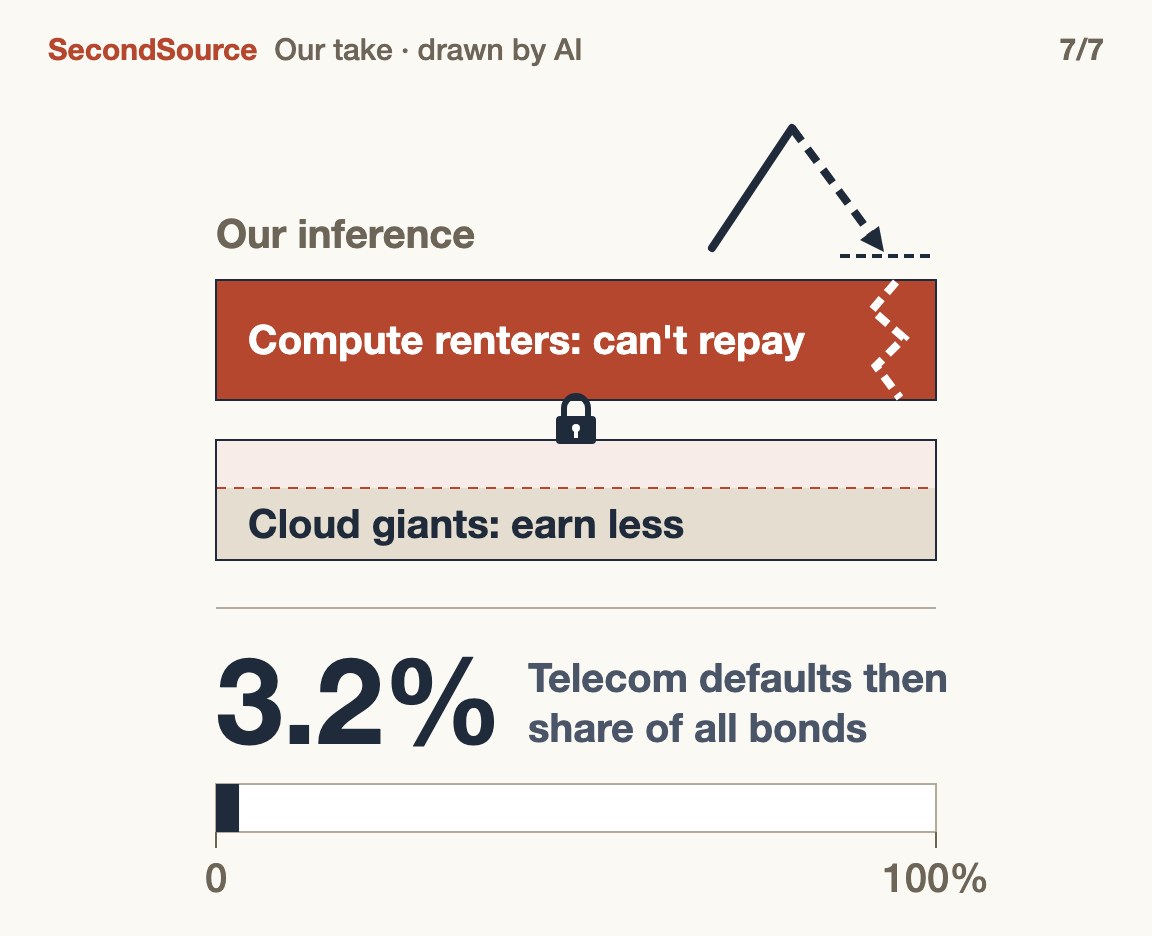
If a glut comes, rental prices may fall first. The compute renters' revenue would drop while their interest bills stay where they are, so this layer is the more likely to see unpaid debts first. The hyperscalers' current filings show no sign of trouble paying rent. What share of operating cash flow that rent takes is not calculated in this report.
The hyperscaler layer would instead see new data centers fail to earn back their cost, squeezing margins and returns on capital. Our read: the outcome would have the same two-layer shape as telecom's.
Leases tie the two layers together. If OpenAI's fundraising falters, the OpenAI share of Oracle's unfulfilled contracts becomes hard to fulfill.
Whether trouble in this layer would become a problem for the whole financial system is a question this report cannot answer. The OECD records that telecom defaults were only 3.2% of bonds outstanding at the time and did not cause a credit crunch. For AI's layer, estimates of the total debt and of who holds it vary widely.
Open ?
Where this piece sits on the trend line: the tree above is the "debt plus circular financing" trend SecondSource tracks. This piece adds one thing: most of the borrowing is done by the companies that rent out compute. Circular financing means a supplier puts money into a customer, and the customer uses that money to buy the supplier's products.
Eight: What this changes, and for whom
- Creditors lending to GPU renters and data-center developers: the collateral is GPUs and leases, and whether the main customers can keep raising money is one of the main risks.
- Hyperscaler shareholders: leases not yet commenced start paying rent in stages from 2027, so the cash flow of those years matters for shareholders, not only today's borrowing.
- Chip and equipment suppliers: in telecom's case, carriers cut capital spending and equipment makers shrank with them (section two). For this AI cycle, no matching order figures are available yet.
- AI teams renting compute from providers such as CoreWeave and Oracle: what these teams face now is rising prices, from the same providers that carry debt falling due soon.
Our call
Part of AI's leverage sits in leases and with the companies that rent out compute; reading only the hyperscalers' balance sheets misses it.
Readings to watch next
Meta's fourth-quarter results, against falsifier 1 below. The market price of CoreWeave's bonds in its third-quarter report: 99.7% of face value at the end of June, and an October report put its 2032 bonds at about 78 cents on the dollar. Whether the H100 spot price index gets a reading after February (section six).
What would prove this wrong
1. Within 21 days of Meta's fourth-quarter 2026 results: if Meta's cash, cash equivalents and marketable securities at the end of 2026 are still no lower than the long-term debt line on its balance sheet (excluding the part due within a year), "the cushion is nearly gone" has not come true for Meta, and section three narrows.
2. By December 31, 2027: if Moody's or S&P downgrades any of the four hyperscalers, citing AI capital spending or lease commitments, the leverage has reached the hyperscalers themselves. Section seven's claim that the hyperscalers' damage is squeezed earnings would then fail, and the call becomes the whole industry under strain together.
3. By December 31, 2027: if getdeploying's GPU rental price index falls below its level of a year earlier (October 2025), while Oracle is not cut to junk and CoreWeave neither defaults nor restructures its debt, the order section seven lays out (rental prices fall first, compute renters fail to pay first) does not hold.
Appendix: where the numbers come from
SecondSource's calculations
- Net cash: Microsoft US$76.8B − US$46.1B (debt principal from the annual report's contractual obligations table) = about US$30.7B. Meta US$82.45B − US$80.922B (long-term debt line on the balance sheet) = about US$1.5B. Amazon (US$78.213B + US$44.775B) − US$128.894B = about −US$5.9B. Alphabet US$242.474B − US$98.165B = about US$144.3B.
- Microsoft leases: leases including imputed interest in the contractual obligations table, US$443.506B, minus the commenced leases in the lease maturity table (operating US$24.706B + finance US$89.686B = US$114.392B) = US$329.114B. That matches the US$329.1B the note gives for leases not yet commenced, so the US$329.1B is inside the US$443.5B. US$443.506B ÷ debt principal of US$46.136B ≈ 9.6 times; this only compares orders of magnitude and is not a leverage ratio.
- CoreWeave's 18-month maturities: second half of 2026, US$4.413B, plus 2027, US$6.184B, = US$10.597B; ÷ cash of US$5.524B = 1.9 times. Weighted effective interest rate of 8.4%: each loan's principal times the effective rate the quarterly report lists, summed, divided by total principal.
Measurement notes
- The four companies' dates differ: Microsoft, Alphabet and Amazon are June 30, 2026; Meta is September 30.
- Microsoft uses debt principal; the other three use the long-term debt line on the balance sheet. On the earnings call, Meta's CFO gave debt of US$83.7B, a figure that includes the part due within a year; on that basis Meta already owes more than it holds. Net cash in this report and falsifier 1 both use the long-term debt line.
- Lease amounts are not an accounting leverage ratio. Oracle's note does not say whether the US$288B is discounted.
- Hyperion's US$27B is development cost; the official announcement does not give the bond amount.
- The CDS readings come only from market reports; no primary market data is available to check them against.
Details left out of the main text
- Telecom defaults: in a study of the same year, NYU professor Edward Altman found that telecom accounted for 52% of the value of US high-yield bond defaults and 36% of the number of defaulting issuers (Altman & Bana). High-yield bonds are corporate bonds rated below investment grade. Telecom bondholders got back an average of 16 cents per dollar. The Wall Street Journal reported at the time that only 2.7% of the fiber laid by 2002 was in use. That figure is taken from the 2023 Fabricated Knowledge analysis; the Journal's original report has no link to check against.
- The eight communications companies on the OECD list: WorldCom, Global Crossing, Adelphia, NTL, XO, Williams, McLeodUSA, Asia Global Crossing.
- The exception among established carriers: Qwest bought the established carrier US West and still ended up on the list of defaulters. Qwest was rated investment grade before it defaulted.
- Alphabet and capital spending: Alphabet's cash includes proceeds from a share sale begun in June, capped at US$84.75B. In July the rating agency Moody's estimated that the major cloud companies' 2026 capital spending would total US$785B (CNBC).
- FactSet: the report on FactSet's count does not say which company is above one times; no figure on the same basis for telecom carriers back then is available to set alongside.
- Microsoft's lease terms: leases not yet commenced run 1 to 20 years.
- A lease being postponed: according to Bloomberg and TechCrunch in September 2026, Oracle sent a force majeure notice to the developer of the Jupiter campus in New Mexico. A force majeure notice invokes a contract clause for events outside a party's control. If the power-supply commitment runs into trouble, Oracle can push back the start of rent by three years. Oracle says the campus remains on its original schedule.
- CoreWeave's interest rate and liquidity: the effective interest rates on CoreWeave's loans, weighted by principal, average about 8.4% (our calculation). The effective rate is the real annual rate once fees and similar costs are spread in. Credit that banks have committed but CoreWeave has not drawn is called undrawn credit; counting it, the total available liquidity in CoreWeave's filing is US$15.55B. In June, The Next Web reported that CoreWeave's credit spread had eased for a time.
- The main customer is expected to burn cash too: according to The Information in September 2025, OpenAI's projection to investors is a cumulative cash burn of US$115B from 2025 through 2029.
- Another list price move: from October 1, Nebius, a GPU rental company, raised its list price for H100 chips from US$3.85 to US$4.50 an hour.
Other accounts
- The hyperscalers are deliberately avoiding leverage: Alphabet switched to selling new shares, and Oracle is also selling shares and taking customer prepayments. That can be read as the hyperscalers actively limiting leverage, which supports the first half of the 2023 call.
- Total AI debt: Bloomberg estimates AI data-center debt at more than US$500B, and Morgan Stanley estimates AI-related bond issuance of about US$570B in 2026. Both are secondhand relays on different bases, and this report rests no weight on them.
- Older chips already near marginal cost: if the H100 spot price keeps falling, loans backed by older GPUs come under pressure first, and that may signal earlier than prices for newer chips.
Sources
- Fabricated Knowledge (Doug O'Laughlin), 2023-10: Lessons from History: The Rise and Fall of the Telecom Bubble
- OECD (Lenain & Paltridge), 2003: After the Telecommunications Bubble, ECO/WKP(2003)15
- NYU Stern (Altman & Bana), 2003-02: Defaults and Returns on High Yield Bonds: The Year 2002 in Review
- U.S. Securities and Exchange Commission: Report of Investigation (WorldCom accounting fraud)
- Microsoft, 2026: Form 10-K FY2026
- Alphabet, 2026-07: Q2 2026 earnings release
- Meta, 2026-10-21: Q3 2026 earnings release
- Amazon, 2026-07-30: Q2 2026 earnings release
- Meta, 2025-10-21: Meta Announces Joint Venture with Funds Managed by Blue Owl Capital
- Oracle, 2026-06-22: Form 10-K for the fiscal year ended 2026-05-31 (FY2026)
- Oracle, 2026-09-11: Form 10-Q for the quarter ended 2026-08-31 (Q1 FY2027)
- Oracle, 2025-09-10: Form 10-Q for the quarter ended 2025-08-31 (Q1 FY2026)
- Oracle, 2025-12-11: Form 10-Q for the quarter ended 2025-11-30 (Q2 FY2026)
- Oracle, 2026-03-11: Form 10-Q for the quarter ended 2026-02-28 (Q3 FY2026)
- CoreWeave, 2026-08-12: Form 10-Q for the quarter ended June 30, 2026
- Fabricated Knowledge, 2026-01-07: 2026 AI & Semiconductor Outlook (Fabricated Knowledge / SemiAnalysis)
- FactSet, 2026-07-23: Hyperscalers Tap External Financing as AI Capex Outruns Cash Flow
- CNBC, 2026-07-24: Moody's says 'unprecedented' AI spending threatens credit quality
- The Next Web, 2026-07: Oracle is one notch above junk after S&P downgrade
- The Next Web, 2026-06: CoreWeave credit rebound
- GuruFocus via Yahoo Finance, 2026-10-15: Oracle's Default Insurance Hits a Record as AI Debt Fears Spread
- The Information via CNBC, 2025-09-06: OpenAI business to burn $115 billion through 2029
- intuitionlabs (relaying the SemiAnalysis GPU index): Cloud GPU rental prices comparison
- SecondSource, 2026-10-18: Is GPU compute tight? The answer is in contract length
Written from the same research and judgments as the Traditional Chinese edition. Sources are linked; we distinguish original documents from reporting and mark what we could not verify.