On a laptop, Simon Willison got the open-weight Qwen 3.8 27B to name the game behind three of four small networks from their weights
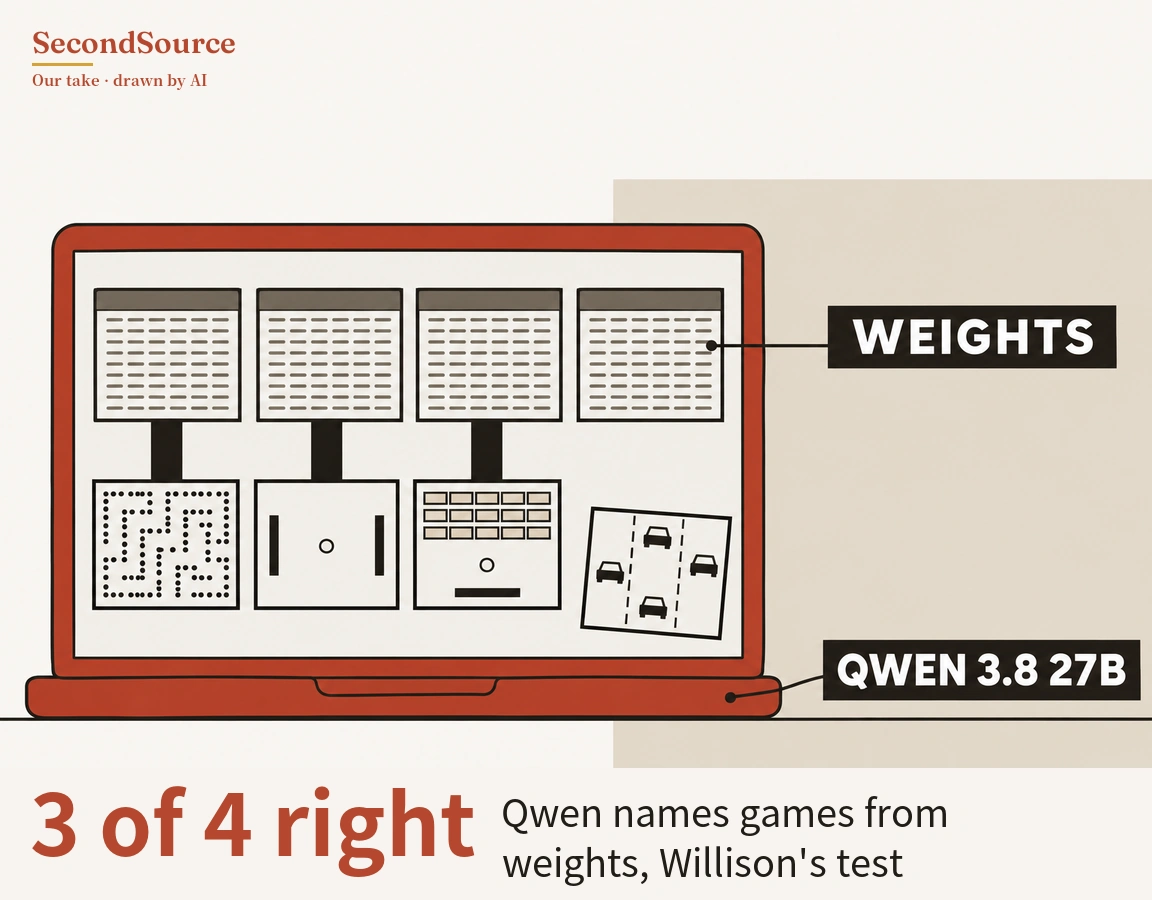
Software engineer Simon Willison re-ran part of a paper's experiment on a laptop on November 3; the paper says frontier models can read and modify the weights of neural networks. In Simon Willison's test, an open-weight model on a laptop did what the paper says GPT-6 Astra can do and identified a small network's task from its weights. No one has reproduced the paper's weight-editing half.
Simon Willison was responding to a paper that went viral on X on November 2. According to the paper's abstract as cited by Simon Willison, "Sparks of Weight-Space Programming" by Rikiya Takehi and co-authors says OpenAI's GPT-6 Astra can tell what a small network was trained to do just by looking at its raw weights. The paper also says GPT-6 Astra can change 0.016% of Qwen3.5-0.8B's weights and lift that model's score on the MATH-500 math benchmark from 7.9% to 48.1%. These results are the authors' own (paper author's post, 2026-11-02).
Simon Willison re-ran only the "reading" half. Willison is a British software engineer and co-creator of Django who has long published reproducible hands-on model tests. Willison used the four small game-playing policy networks the paper released. The weights went into the prompt as floating-point numbers, with no tools, and the model was asked which game the network plays. On the laptop, Willison ran Qwen 3.8 27B, an open-weight model of about 17 GB. Qwen named Pac-Man, Pong and Breakout correctly and got Freeway wrong, taking 46 minutes to 1 hour 5 minutes per question. On the same Breakout question, Moonshot AI's Kimi K3.1 Pro, run through the cloud service OpenRouter, answered correctly in under 10 minutes; the hardware differs, so the times can't be compared directly with the laptop's (Simon Willison, 2026-11-03).
Simon Willison's conclusion is that the paper "combines two topics that I think deserve to be treated separately." Willison finds that reading weights to identify a task holds up, though Willison writes, "I expect a sufficiently experienced human being armed with a notepad and a pencil could get there with enough effort." Using tools to modify another model's weights is the half Willison didn't test, and no one has reproduced it yet. spaCy author Matthew Honnibal called the paper misleading for mixing the two, and engineer Sean Goedecke pointed out that the weight-editing steps are the same ones a human researcher would take; both views are as relayed by Simon Willison.
Not proven yet: one person, four questions run once each, one open-weight model How we checked →
Next to watch: whether an independent team uses the paper's released code to re-run the weight-editing half, and whether anyone shows that open-weight models can't read larger, more general networks.
Source and checks
This item ran in the brief of Nov 4, 2026, alongside 10 other items. How we checked it, the quote checks and what was still missing that day are on that issue's How we checked page.
Cite this item
SecondSource (2026). "On a laptop, Simon Willison got the open-weight Qwen 3.8 27B to name the game behind three of four small networks from their weights." https://secondsource.io/en/news/2026-11-04-4/. Accessed access date.